
Mass Shooting Metrics
It is time to look at the other types of “mass shootings,” given that what the public perceives they are, and what they are really, are quite different.
They also inform us that street gang violence has many manifestations.
Take-aways
- Alternate definitions of “mass shooting” obfuscate street gang causation.
- Highest victim and perpetrator rates are for Blacks in active gang ages.
- Higher urbanicity is correlated with higher mass shooting victims when deaths and injuries are both included.
Definitions
Amtrak once drastically improved their horrible on-time record by changing the definition of “on time.”
Something similar has happened with “mass shootings.”
In the 1990s, criminologists defined “mass PUBLIC shootings” (note the added word … it is important). Given their well-crafted definition 1, decades of research was committed to understanding mass public shootings.
And this is the public’s general perception of such events. They think of Sandy Hook, Pulse Night Club, King Soopers supermarket.
But on average for the 21st century, the United States has about four such events each year. That is four too many, but a relatively low number, and outside of major outlier events (i.e., Las Vegas country music massacre), relatively few victims compared to the total number of gun homicide victims by all causes.
This caused some people, without the aid of criminologists, to devise definitions for “mass shootings” as opposed to “mass public shootings.” And this in turn created a lot of public confusion.
The three major differences between the traditional, criminology-derived definitions of “mass PUBLIC shooting” and “mass shooting” involve the latter allowing for:
- Incidents occurring in private places
- Incidents involving other crimes (i.e., a robbery gone wrong)
- Incidents where people were wounded but not killed
This resulted in some wildly different headline numbers (and some claim the redefinitions were designed to generate headlines).
High-Level
The high-level comparison of these definitions and less-than-stellar data sources show the extreme distortion of public perception, where a big problem resides, and the horrible condition of crime data.
For the year 2023 (the most recent year of data from the FBI’s National Incident-Based Reporting System, or NIBRS) we see the following:
| Mass PUBLIC Shootings (MPS) | Gun Facts Mass Public Shooting DB = 7 |
| Definition 1 (4+ killed) | FBI data = 51, GVA = 40 |
| Definition 2 (4+ shot) | FBI data = 471, GVA = 659 |
The Gun Violence Archive is an unreliable source given the limitation of their input sources and methodologies for data collection. But the 2023 FBI NIBRS data ain’t great either, having major law enforcement agencies (i.e., Los Angeles, California) not reporting at all. And being a “new” system, some NIBRS data entries are simply wrong (Columbia, MO had a mass shooting event where one person was killed and four wounded, but the city recorded it as five murders). Things get a bit messier since 2023 was well above average for the number of MPSs due to a pair of incidents with Asian perpetrators (which is statistically very rare), both in California (Monterey Park and Half Moon Bay).
But the ballpark numbers are “close enough” so that a deep dive in the NIBRS data provides insights about the alternate definitions for “mass shooting.”
We combed through all the competing definitions spawned by activists and media (though the difference between those groups is vague). Two commonly used definitions are:
DEFINITION 1 (DEF-1): 4+ killed, anywhere
DEFINITION 2 (DEF-2): 4+ shot though not necessarily killed
For both, the perpetrator(s) are not included in the killed/injured tallies, and the event may be associated with another crime. And, yes, DEF-2 is a superset of DEF-1.
Age and Race
We’ll repeat it again: we hate discussing race as a factor in crime. At Gun Facts, we do not believe and have failed to find evidence that being of one or another race makes someone more prone to violence as a genetic factor.
 |
 |
 |
 |
 |
 |
 |
 |
But, the numbers say that violence is committed by and perpetrated upon different races at different rates, so we have to dig into that data.
It is also important because, as the National Gang Center reported, the three primary metrics associated with street gang participation are race, age and urbanicity.
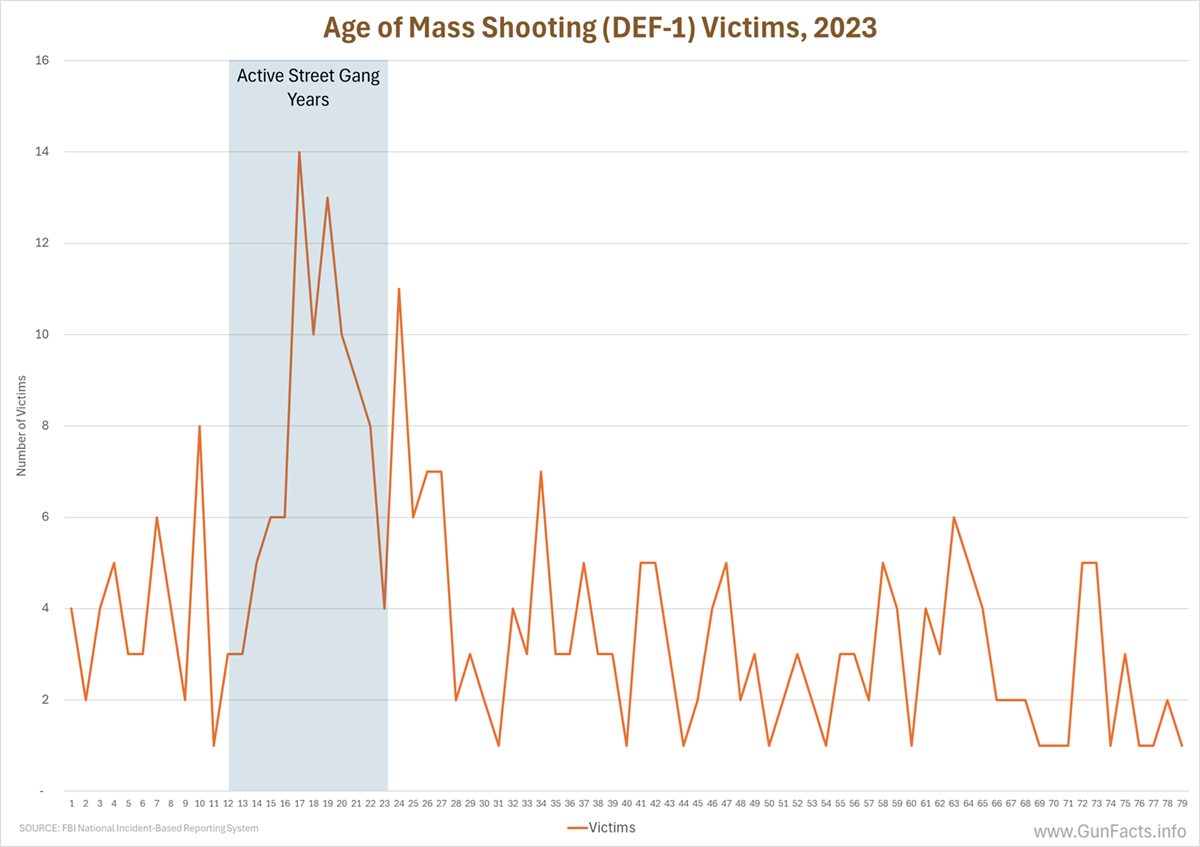
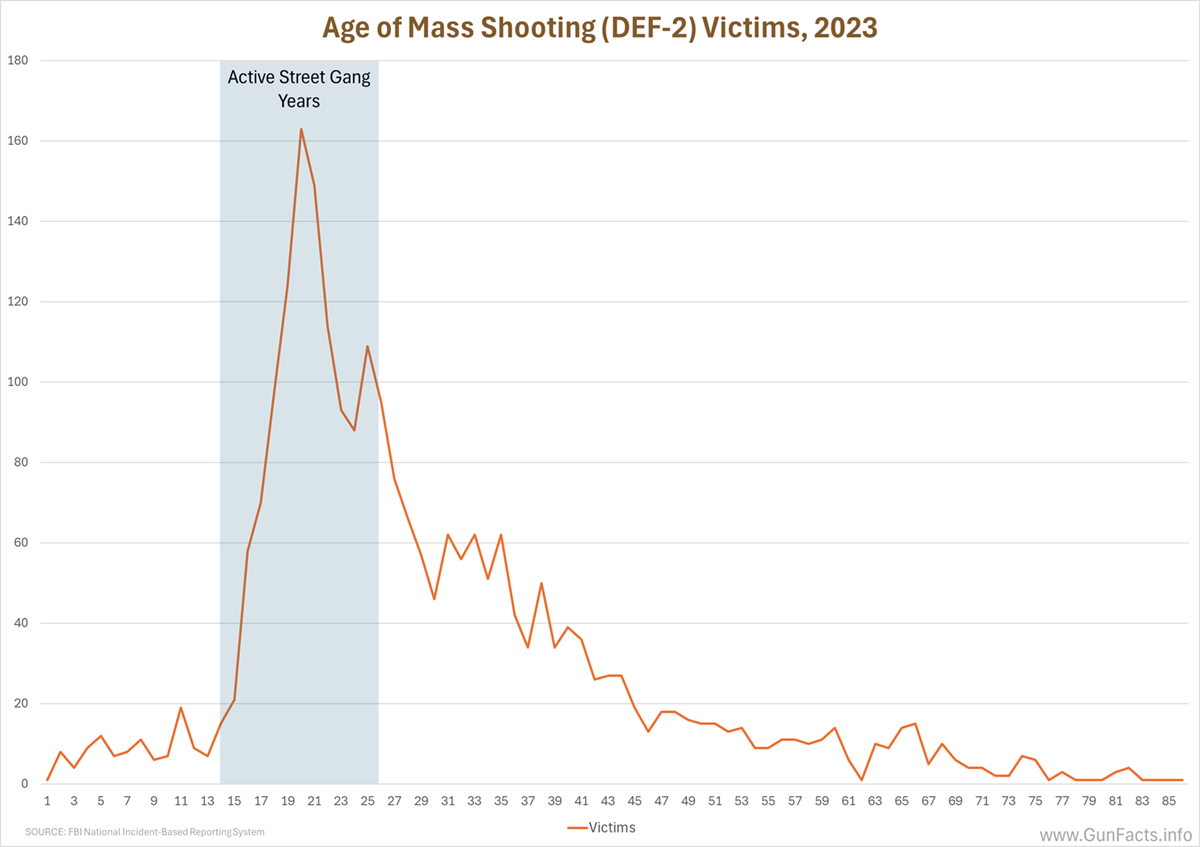
Age is doubly important because violent crime in general, and gang activity in particular, are a young man’s game. The Nation Gang Center reports that the active age for street gang activity is in the range of a person’s teens and early 20s.
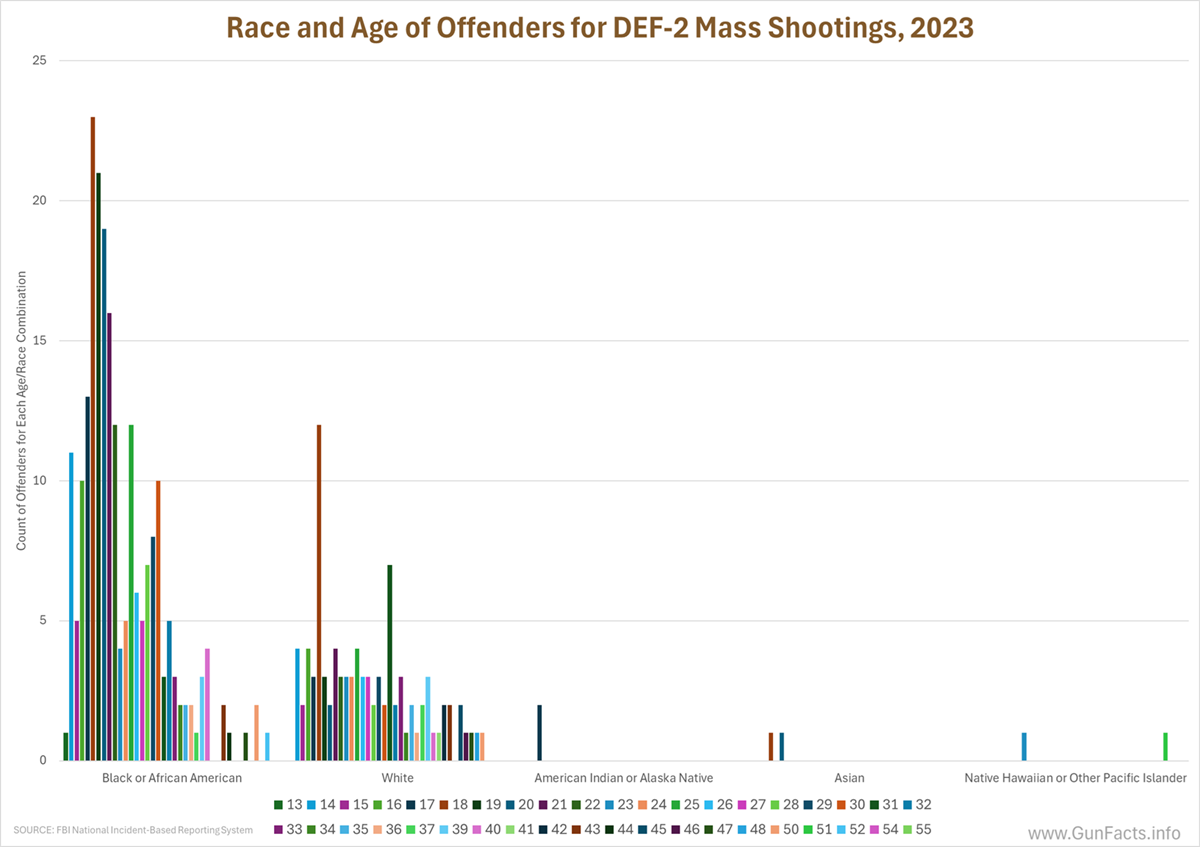
As these two charts show, for mass shootings of either alternate definition, the heat is in the street gang age bracket.
The chart for DEF-2 may be the more incriminating. Watch your news feeds for events where “disputes between groups” led to an exchange of gunfire. Early reporting does not allow the media to guess if the “groups” were gangs or even gang affiliates. Hence, the media equivocates… as they should, since the mainstream media misreports too often as it is.
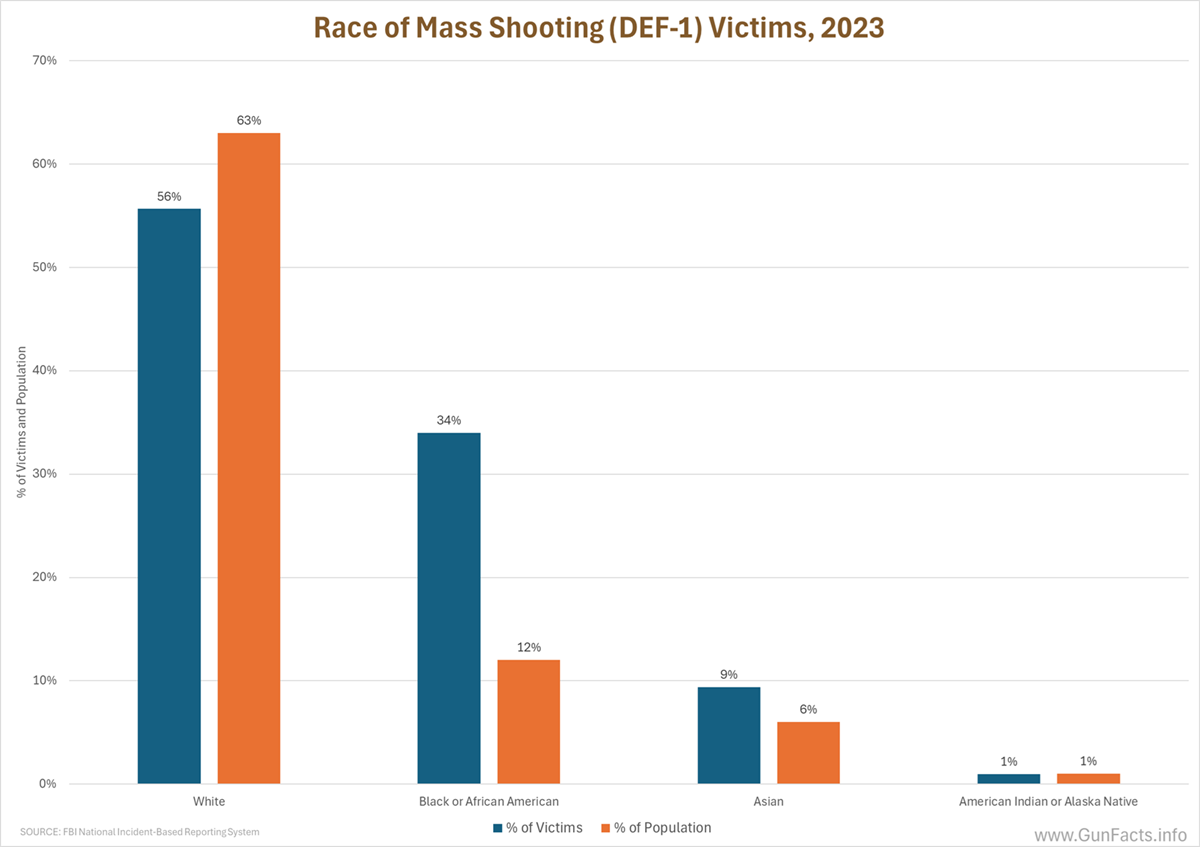
That then brings us to the uncomfortable analysis of race. And the data is very uncomfortable.
Among the races logged by the FBI, Blacks are victims of mass shootings at nearly three times the rate that their share of the population would otherwise predict. Whites are slightly underrepresented. And in the odd year of 2023, where there were two MPSs committed by Asians on other Asians, they are marginally overrepresented.
But it gets worse.
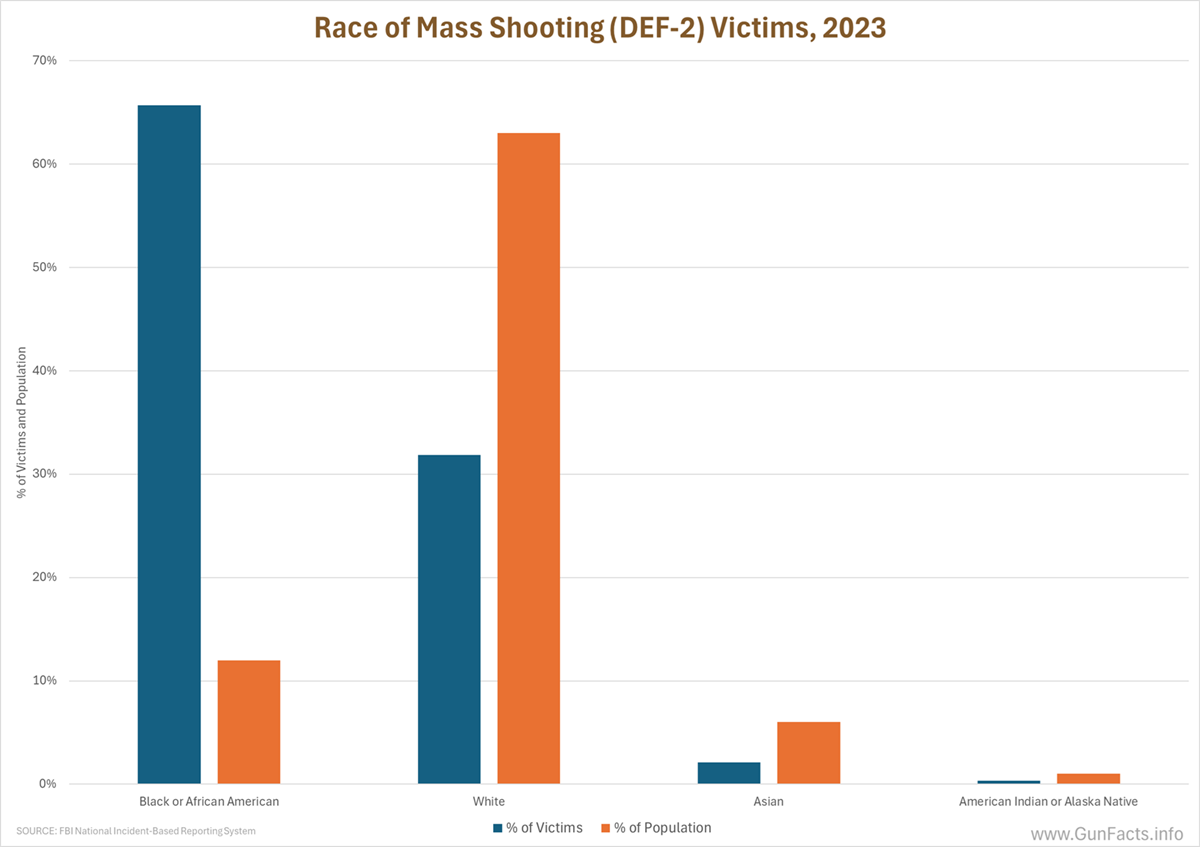
The 3X rate for blacks was for DEF-1, where 4+ people were killed. For DEF-2, where wounded people are included, Black victims are overrepresented at 5.5 times what their share of the population would predict.
To put it as delicately as possible, mass gun violence by assumed Black gang members/affiliates in crowded settings leads to a lot of wounded bystanders.
That’s the victims. Similar patterns appear for the offenders (perpetrators) that are known (keep in mind that the Gun Facts Top 15 Murder County study showed an alarmingly low clearance rate for gun homicides in the same cities with notorious gang activity, and thus a high number of unknown perps).
For offenders, we see the same skewing associated with gang-age Blacks (the chart for DEF-1 is similar in its curves). Hence, the age and race of both mass shooting offenders and their victims are the same.
This is different from mass PUBLIC shootings where the ages and races of victim are often random, or the ages are higher (typical in workplace MPSs).
Urbanicity
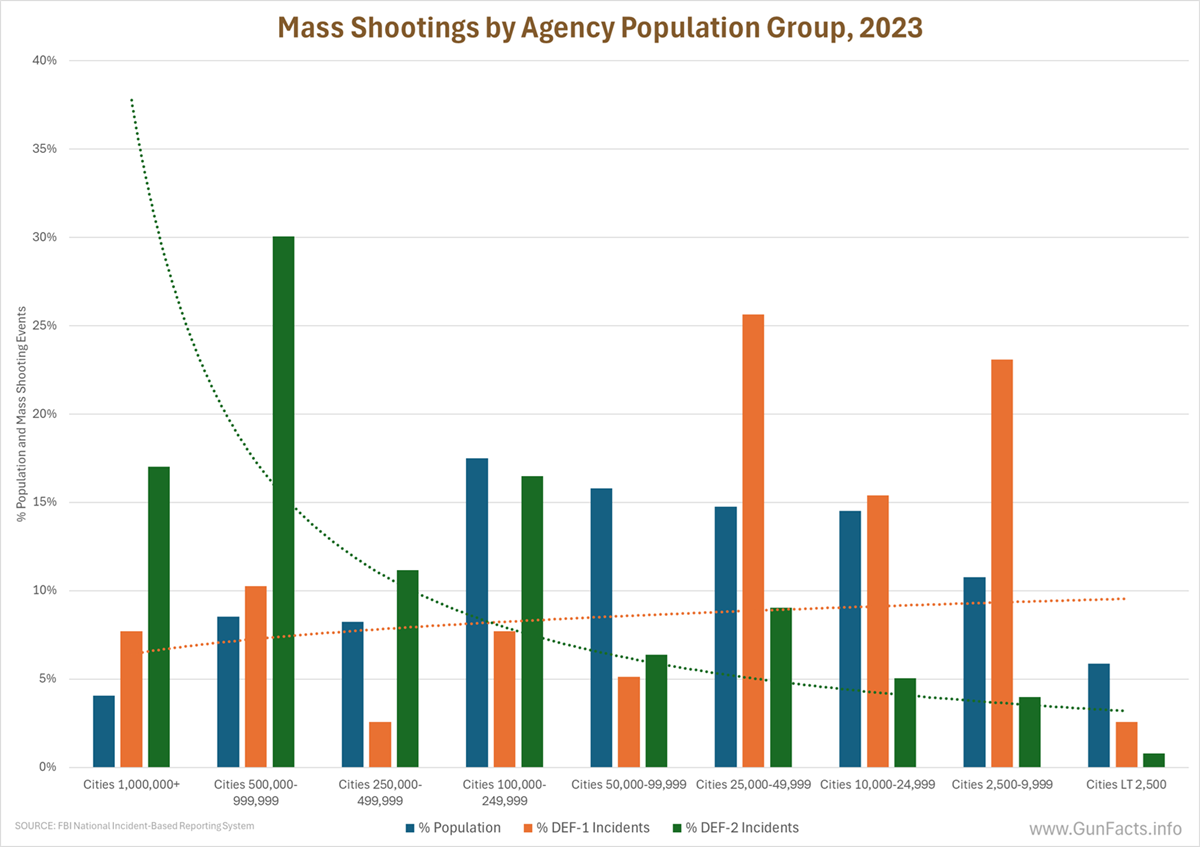
The third vector that the Nation Gang Center reported on gang demographics was the degree of urbanicity. The larger the population density, the higher the rate of gang activity.
However, we do see both confirmation about urbanicity leading to more mass shootings, but also a little divergence.
Keeping in mind that the 2023 NIBRS data is missing a few major metro areas, including all of Los Angeles, we see DEF-2 mass shootings occurring with a rate higher than their populations would predict. Yet for DEF-1 incidents, there is a rise as the jurisdictions’ population gets smaller. Since DEF-1 incidents are likely more highly targeted and focused events (i.e., out to kill specific people) and DEF-2 are more wanton, this may be understandable. Smaller population areas have less street gang participation rates and thus lack the indiscriminate shootings associated with gangs.
The important bit is that with higher populations, the rate of people being killed and wounded in mass shootings rises significantly.
Private vs public
As the man once said, location, location, location.
We noted that the definition of the criminologist-defined mass PUBLIC shootings required that they happen in public (this includes generally publicly accessible areas like offices). The alternative definitions lack that requirement.
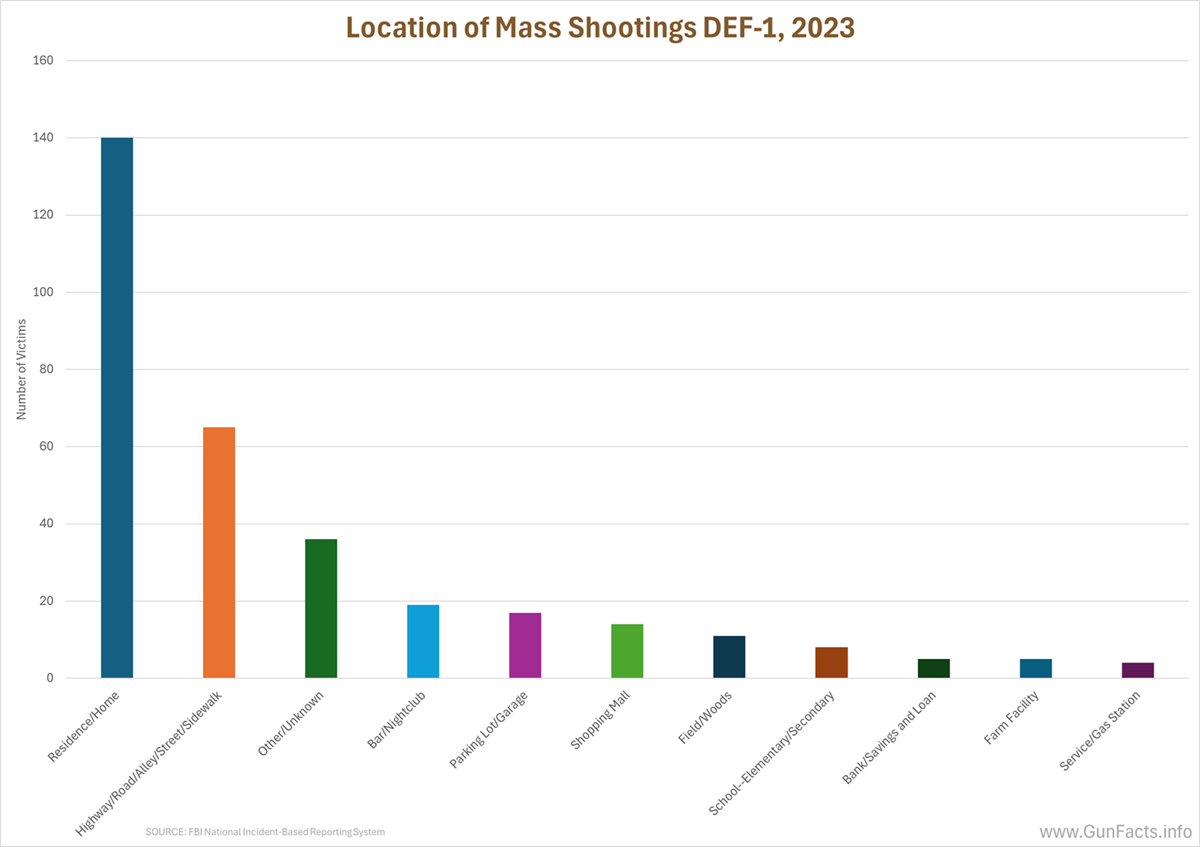
We see that for DEF-1 events, most occur in private, not public. Recall a mass “public” shooting in King City, California in 2024. It technically occurred in a residence front yard … and was gang related. When the definition of “mass PUBLIC shooting” was obscured by “mass shooting,” part of the increase in annual events was the inclusion of instances occurring in non-public spaces.
This is important because people have a great deal of control over what non-public place they occupy. In the King City example, it was people attending a birthday party where gang members were being targeted. This association and the location were elective. Being at the grocery store is not.
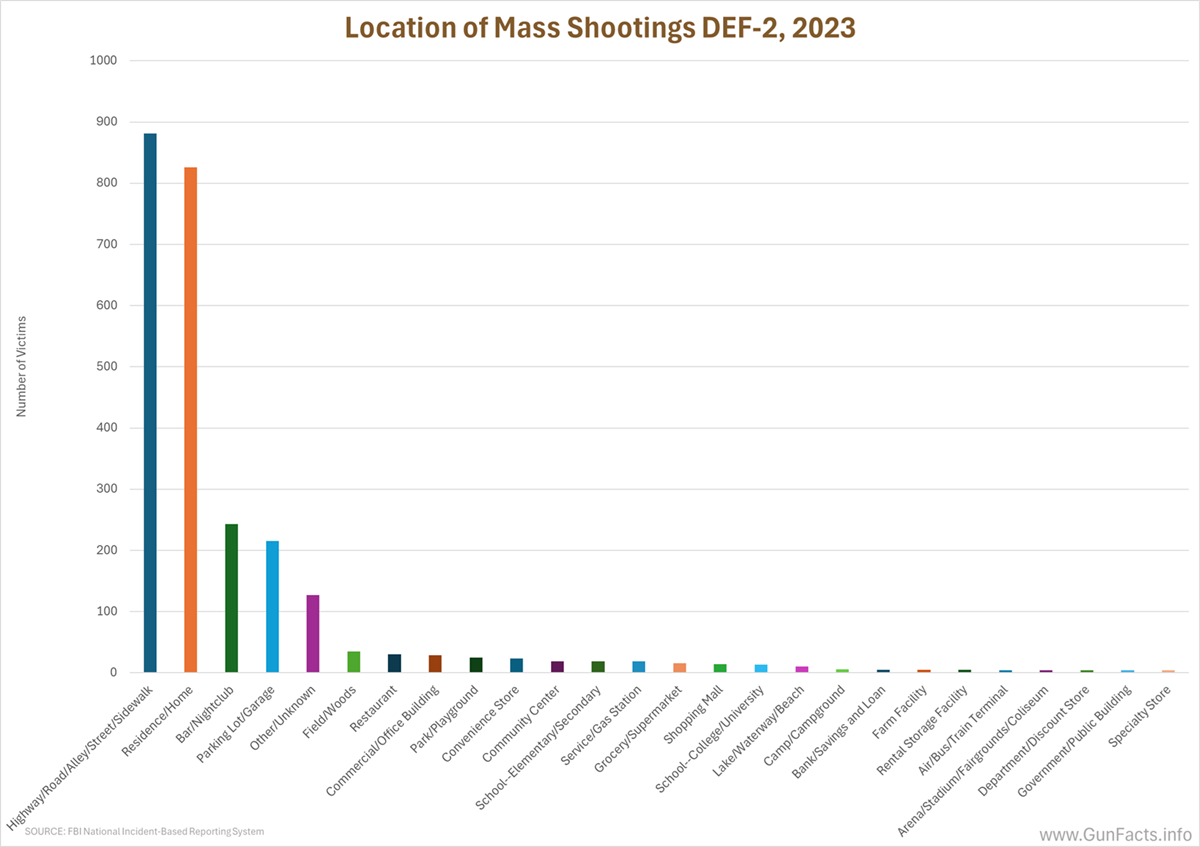
For DEF-2 incidents, the leading locations change, but it is still “on the streets” or in a residence that strongly lead in terms of mass shooting locations.
We’ll note that the broad FBI category of “Highway/Road/Alley/Street/Sidewalk” is less specific than we would like, but “street” gangs are called that for a reason, and committing violence on “streets,” “sidewalks,” in “alleys” or along “roads” completes the brand.
Public Perception
One thing to keep in mind is that the cut-off for all definitions of “mass shooting” discussed here is four victims. Other definitions go as low as three, which would amplify most or perhaps everything you learned today.
Most people are not aware that Blacks are the number one victims of gun violence on a rate basis. They are also unaware that headlines bemoaning “mass shootings” obfuscate who is being shot and why.
Definitions of Mass/Public Shooting and Active Shooter
| Definition / Source | Min. # of Victims (Shot) | Min. # of Victims Killed | Must Be Public | Shooter Excluded from Count | Not Part of Another Crime | Notes |
| Mass PUBLIC Shooting (CRS / Violence Project) | — | ≥ 4 killed | Yes | Yes | Yes | Formal criminological/public policy definition focusing on indiscriminate firearm homicide in a public setting (used by National Institute of Justice/The Violence Project and Congressional Research Service). |
| Active Shooter Incident (FBI) | n/a | n/a (no specific fatality threshold) | Typically | n/a | Yes | FBI defines an “active shooter” as someone “actively engaged in killing or attempting to kill people in a populated area.” It does not require a particular number of victims and excludes self-defense, gang/drug violence, domestic disputes, etc. |
| Gun Violence Archive (GVA) | ≥ 4 shot | None required | No | Yes (generally) | No | GVA counts any incident where four or more people are shot (injured or killed), excluding the shooter. It does not restrict by motive or context. |
| Mass Shooting Tracker | ≥ 4 shot | None required | No | May include | No | A crowdsourced site; includes any incident with four or more people shot, sometimes counts the shooter in victim totals. |
| Stanford MSA Data Project | ≥ 3 shot | None required | No (context varies) | Yes | Sometimes | Academic project using a 3+ shot threshold and excluding gang/crime-related shootings. |
| Everytown for Gun Safety | ≥ 4 shot | ≥ 4 killed | No | Yes | No | Everytown defines mass shootings as incidents where at least four people are shot and killed, excluding the shooter(s); includes private and public settings. |
| Mother Jones (Magazine) | ≥ 3 killed | ≥ 3 killed | Yes | Yes | Yes | Mother Jones uses a conservative definition: an indiscriminate public rampage with three or more killed by a single attacker, excluding gang, robbery, or unclear perpetrators. |
| CBS News (media) | ≥ 5 shot | n/a | No | Typically | No | Some media outlets adopt a 5+ victims shot threshold; definitions vary across outlets. |
| Congressional Research Service (CRS) Broad Mass Shooting (not only public) | ≥ 4 shot/killed | ≥ 4 killed | No | Yes | No | CRS sometimes uses a broader measure of mass shooting (not always limited to public spaces) with a 4+ killed threshold in secondary reporting. |
| Mass Killing (Federal Law, IAVCA 2012) | n/a | ≥ 3 killed | No | Yes | Yes | Mass killing is legally defined (three or more deaths in a single incident), not limited to firearms, and often used in federal policy and data programs. |
Notes:
- Public shooting events where four or more people are killed, not including perpetrator(s), within an hour, not part of another crime. ↩
In a recent article entitled “Americans Aren’t Traumatized Enough by Gun Violence” they wrote
–“white men … commit disproportionately more mass shootings” but this is only true if you define mass shootings as killing 4 or more people
–“For more than 20 years, there were no mass shootings in Australia.” but Australia uses a definition requiring 5 or more dead
–“There were 392 mass shootings in 2025 alone” but the criterion for that total is 4 or more injured
Recent discussion with another person regarding trans shooters given the recent shooting at a hockey game by a trans. Seems to be a lot of them in the last 4 years. I was looking at your mental health mass shooting page and was thinking that this is a mental disorder. Maybe it’s time for an update. Trying to find a source of data that has compiled the list of trans shooters. Thanks for this page.
It is an interesting topic.
That said, the frequency of mass public shootings is small. The number of them committed by trans people is very small. Thus, any statistical measures would be flaky.
Our hunch is that some subsegment of people with generalized mental health disorders also have gender dysphoria. The medical community is of the opposite mind, thinking that people with gender dysphoria develop anxiety, depression, and social, academic, or vocational impairments while dealing with the personal/social/family tensions it creates.
The latter pairs better with what we know about mass public shooters committing the crime de to grievances.