
Scoping Gang Violence
To say that gangs are the principal source of gun violence in America is akin to saying a Russian invasion is a little noisy.
We at Gun Facts have repeatedly noted that gangs cause most of the bloodshed. A new (to us) academic work helps to illustrate this and to compare with some of our estimates as well.
It’s worse than we thought in some respects.
Take-aways
- Gun homicides are primarily street gang related.
- This violence is highly concentrated in a handful of metro areas.
- Focusing on core gang members reduces street gang gun homicides.
Gang related… multiple definitions
We first must discuss yet another problem with criminology data consistency.
There is no single and uniformly applied definition of “gang related” for crime circumstances. Each locality applies their own… if they even bother with writing down a formal definition. Hence, any national data you have seen concerning gang-related violence is ± a lot.
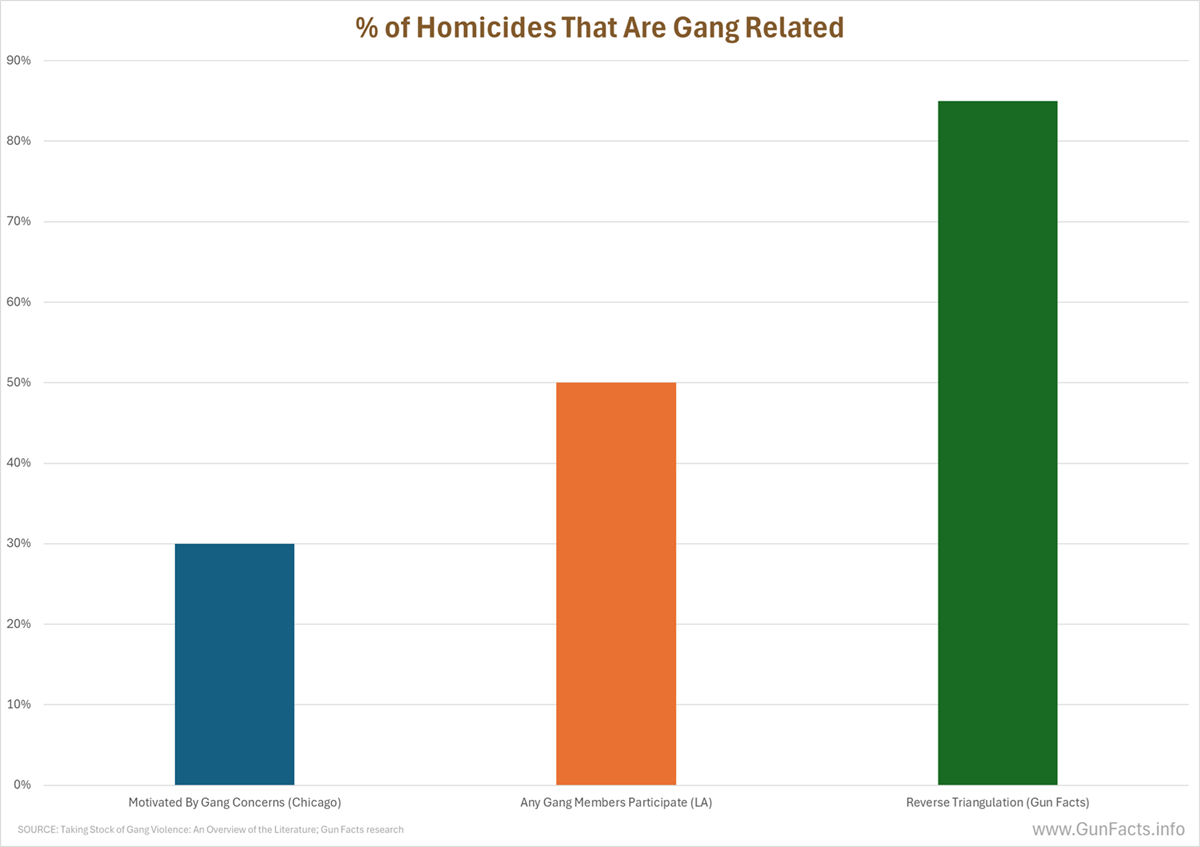
How broad are the definitions? Enough so that one academic review of crime data claims that between 30-50% of homicides are gang related. That’s a wide gap, and that is far below our estimate of 85%.
Much like the concept oof “mass shootings,” the devil is in the definitions.
The “Chicago definition” holds that a homicide is gang related only when there is evidence the killing was motivated by gang concerns. Conversely, the Los Angeles definition is when gang members participate even if the motive is not clearly gang driven.
Because of this, LA will report gang-related homicides at twice the rate of Chicago.
Keep Osborn’s Law mind as we explore the data: Variables aren’t and neither are constants.
Gang-related share of homicides
Aware of the inconsistent nature of agency reporting on gang-related homicides, Gun Facts long ago triangulated gun homicide data with the demographic profiles 1 of street gang members (age, race, degree of urbanization) to come up with our own estimates (see Gang Triangulation).
 |
 |
Our estimate was much higher than others, though this is easily explained.
The academic estimates (the 30–50% range) were based on police reports. This reporting includes only cases where confirmed participation occurred… in other words, where the perpetrator(s) were identified.
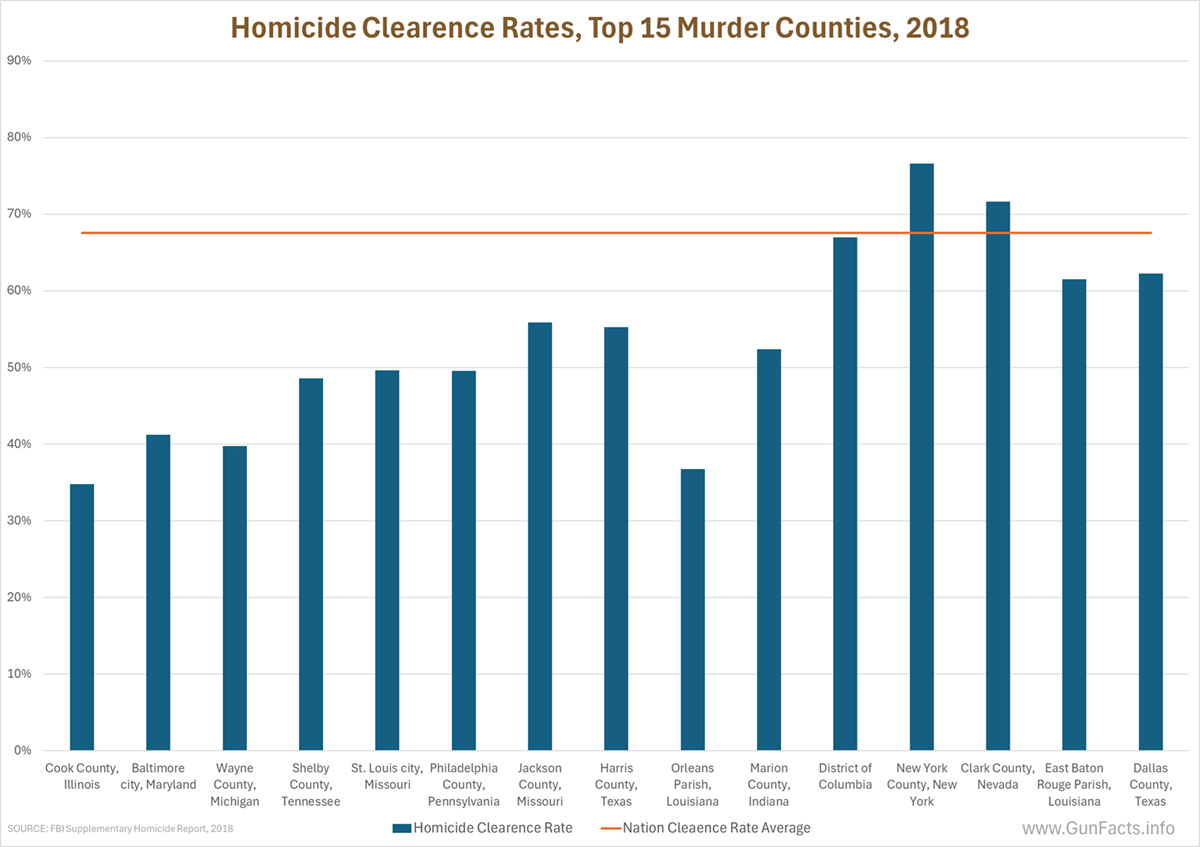
But many of the agencies in the most murderous counties of the United Staes don’t solve many homicides and also have large street gang populations. Our Top 15 Murder County study showed that homicide clearance rates can be as low as Chicago’s 35%… and they have been accused of padding their numbers 2 so the rate is likely lower still.
The point is that a lot of murders, and thus a lot of street gang murders, go unsolved. Nationally, 32% are not. Thus, police estimates, at least those based on agencies’ rules for classifying homicide circumstances, are lowball estimates on a good day.
But let’s take the LA definition as being more realistic. The Chicago definition (30%) requires that a murder facilitates a gang objective. But there are countless murders that were committed to fulfill gang objectives, where the police lack evidence to prove it. The LA definition is broader and only requires an offender gang member to have been involved.
Yet, the LA definition is also a lowball due to the 41% of their homicides being unresolved (at least in the year of our study).
We took a different approach that lacks instance-by-instance validation of gang involvement but does model gang demographics to the population and at least lands us in the ballpark. So, it is safe to summarize that between 50 and 85% of gun homicides are street gang related (the LA model and the Gun Facts model).
High-Level Data about Street Gang Violence
There are many more categories of crime than just homicides. The body count does not tell us about failed homicides, negligent homicides, assaults, rapes, et cetera.
| Topic | Statistic |
| Cities with persistent gang homicide problems (1996–2012) | 65.3% of sampled cities |
| Estimated number of gangs (2012 rebound) | ~30,700 |
| Core gang member arrest rate | ~70% higher |
| Core members participation in gang activities | >= 2X higher |
| Retaliation’s role in gang homicides | >3X more motivating |
One review of literature 3 gives the high-level stats, provides a few more interesting tidbits, and (re)introduces a reality that in turn leads us to reviewing possible solutions.
At least for larger population areas, two thirds of those cities have “persistent gang homicide problems” (the obvious insult to those cities is that with such horribly low homicide clearance rates, it is no wonder that the problem is persistent).
This is perhaps the foundational number. When that many cities cannot get control of their street gangs or the murders committed by those gangs, the USA as a whole has an unnecessarily high murder rate, distorted by these unmanaged cities. Recall from our Top 15 Murder County study that a mere 15 out of 3,140 counties have 24% of the gun murders but only 8% of the population. It is localized inability or political fecklessness in these cities that makes the country look bad.
Then there is the raw count. The literature says there are 30,700 street gangs in America, which equates to 614 different gangs for each state on average (but there are shockingly few street gangs in Alaska, Montana, and other thinly populated regions, which then skews the number of gangs higher in more densely populated states). Keep in mind that police in major metro areas have nearly all the gangs to deal with (LA claims 400+ gangs, Phoenix 300+, Houston 300+, etc.).
The academic research shows that in large cities, 30–50% of all homicides are gang related. In large metro areas (more suburbs), only 20% of homicides are gang related. Nationally (which is skewed by those large cities) the rate is 13%.
Summarized:
- Big cities have persistent (even intergenerational) street gang problems.
- They have most of the street gangs.
- Their “gang share” of homicides is vasty higher.
And these factors may not be the biggest problem.
Core Street Gang Members (a.k.a. Super Killers)
Within street gangs are the worst of the worst, and they come in two overlapping categories:
- Super Killers: This is the name Gun Facts applied to gang members who kill often and without remorse. Long ago we noticed a number of agencies making public statements along the line of “for each gang member in custody for a homicide, they are the lead suspect in 2–3 other murders.”
- Core Members: Gang members who are intrinsic to the gang’s structure, ethos, and activities. The also show intellectual/emotional deficiencies (e.g., low impulse control, low school performance, more truancy, etc.), aggression (e.g., more willingness to fight, low desire for rehabilitation, etc.), and group involvement (e.g., participate in spontaneous activities, contribute more to the group, desire to lead, etc.). 4 (2006).
We do not know what the overlap is between these two groups of people, but we would not be surprised if it neared 1:1.
What is important here are the degrees of concentration of street gang mayhem.
- Concentrated in large and major metro cities
- Concentrated in specific neighborhoods in those cities
- Concentrated to a few individuals within gangs in those neighborhoods
That’s why there were 617 murders in Chicago in 2023 and about the same number for the entire state of Alabama which had twice the population.
| Core gang member arrest rate | ~70% higher |
| Core members participation in gang activities | >= 2X higher |
Per the academic reviews of “core” gang members, we see that this concentration point has a tendency to get arrested much more often than their gang peers, and we suspect they avoid many arrests because they are more alert, experienced, connected, and prepared when committing their crimes. We also see that when a gang activity (which more closely matches the Chicago definition of “gang related”) is in play, they are twice as likely to be involved.
Mathematically, these core members are a point of interest as they not only commit more of the gang murders, but also because their aberrant behaviors influence other and especially younger gang members.
They also offer the best approach to lowering street gang gun homicides and maybe cripple gang culture… which might help implode gangs themselves.
Controlling Street Gang Homicides
Many things have been tried to reduce street gang violence, and thus street gang gun homicides. The results are varied with two being proven effective for different reasons. The primary approaches are:
- GET TOUGH ON CRIME IN GENERAL: Proven effective
- PREVENTION THROUGH ENVIRONMENTAL DESIGN: Limited, temporary
- CIVIL GANG INJUNCTIONS: Moderate
- SUPPRESSION: Proven effective
America conducted a mass experiment using get-tough-on-crime laws. In the late 1980s and into the early 1990s, some such laws (mainly “truth in sentencing”) were passed and there was a measurable effect. But violent crime was still high and rising.
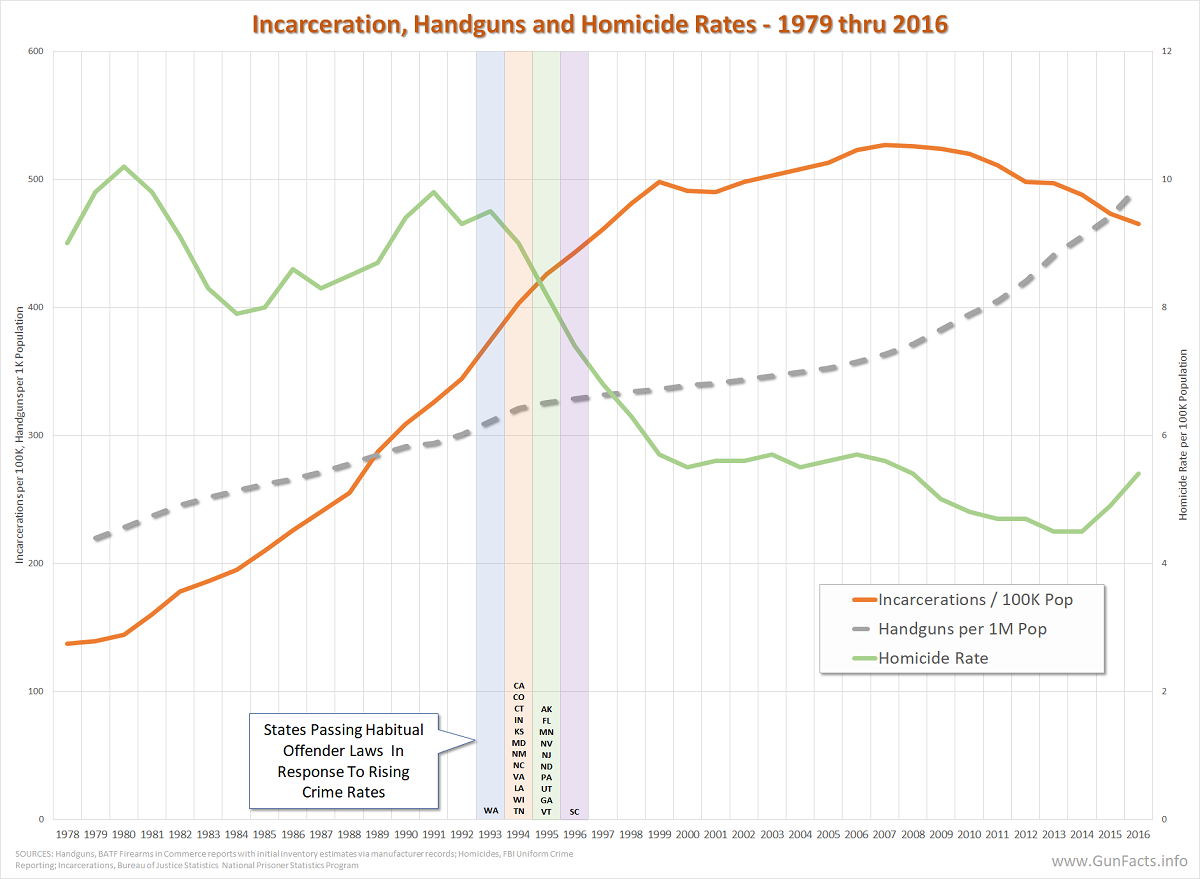 Between 1993 and 1996, 24 states, with more than half of the country’s population, passed habitual offender laws. These laws were designed to put people who committed multiple felonies in prison for extended periods of time, up to life (i.e., Three Strikes, 10-20-Life, etc.).
Violent crime plunged. California processed near 90,000 such people in the first decade of their 1993 law being passed, and Cali’s violent crime rate dropped from 40% above the national average down to the falling national average in that decade.
Within the population of habitual offenders are a lot of street gang members. We are unaware of any solid data that identifies how many second and third strike prison inductees were street gang members. But given their noted repeat criminal activities, this subset if likely large.
| Dimension | Prevention – Environmental | Prevention Civil Gang Injunction | Suppression (Ceasefire) |
| Primary mechanism | Alter physical environment to reduce opportunity | Disrupt gang cohesion and public association | Direct deterrence of core violent actors |
| Typical unit of intervention | Street layout, access control | Named gang members + geographic safety zone | Small number of high-risk gangs/individuals |
| Measured outcome | Homicides, assaults | Violent crime, individual offending | Youth homicide, gang shootings |
| Typical short-term effect | Significant decline while active, but … | 5–10% reduction in violent crime | 30–66% reduction in targeted violence |
| Long-term persistence | Weak once controls removed | Mixed; often fades after ~2 years | Mixed; sometimes durable |
| Largest reported effect | Temporary suppression of gang homicides during intervention | 18% long-term total crime reduction (best-case study) | |
| Risk of rebound/displacement | High when environment restored | Moderate; sometimes violent reorganization | Moderate; depends on fidelity |
Of the other modes, the results are mixed. But on the surface it is obvious that the more specifically a strategy targets gangs and core gang members, the more effective it is.
Environmental changes (leveling blighted houses, blocking streets known for drive-by shootings, etc.) do work, but the effects tend to be short lived. Gangs, like any other pathogen, mutate. The centers of activity morph rapidly and the violence relocates. But the main problem is that it is not specific to gangs. The tactics are generalized to a neighborhood and not to any gangs in said neighborhood.
The first true gang-focused intervention methods are Civil Gang Injunctions (CGI). CGIs are restraining orders that prohibit gang members from engaging in proscribed antisocial behaviors within a designated area. CGI’s prohibit gang members from illegal behaviors (e.g., possession of drugs, firearms, creating graffiti, etc.) and some otherwise legal behaviors (e.g., curfew violations, associating with other gang members).
Like any program, the effects last only as long as the enforcement does. Scattered research shows that CGIs typically wane within the two years of implementation. Yes, they do reduce violent crime by about 5–10% within a CGI designated zone, and some studies show long-term reductions of 18% in total crime, though that reduction is mainly in aggravated assaults.
Where we see significant promise is with targeted suppression. Programs that use every element of local government to focus on core gang members (which includes the super killers) have deeper and longer lasting effects. 5
One such program was Boston’s “Operation Ceasefire” (the Boston Gun Project). There was a 66% drop in youth homicides and an overall 31% reduction in gang shootings (which started ticking back upwards when the program was shuttered in the year 2000).
Gang activity suppression programs have two primary goals:
- Inhibit gang member’s antisocial behavior through severe and swift punishment (i.e., specific deterrence).
- Discourage potential gang members/associates’ antisocial behaviors through “preventive consequences of punishment” (i.e., general deterrence).
The reason it is effective is that it focuses on core street gang members and uses a problem-oriented approach where local law enforcement focuses on particular problems / gangs / core members, and applies tailored responses.
Street Gang Gun Violence in a Nutshell
Swiftly summarizing:
- Street gangs are responsible for 50–85% of gun homicides, depending on how you define “gang related” and measure it.
- Most gang violence is committed by core members (and among them, super killers).
- This problem is extremely concentrated in a few metro areas, and within those cities, just a few neighborhoods.
- Targetting core gang members is the most effective solution even when it is a byproduct of another effort (i.e., Three Strikes).
The question is, when will all of those Top 15 Murder Counties get with the program and focus on the well-documented key problems and proven solutions?
Notes:
- National Gang Center, Department of Justice ↩
- ”Digging into the details on Chicago’s murder clearance rate”, Chicago Sun Times, April 4, 2022 ↩
- Taking Stock of Gang Violence: An Overview of the Literature; Valasik, Reid; 2019 ↩
- Violent Crime, Violent Criminals; Klein, Maxson; 1989 ↩
- Authorities inform at-risk youth that violence will be met in a fast and greatly enhanced manner. These schemes utilize a graduated scale of sanctions and resources that can be leveraged against a gang and its members at any time. Some tactics include increased scrutiny on low-level offenses, stricter enforcement by probation and parole officers, seizing assets of drug-related offenses, serving outstanding warrants, more severe terms for bail, and greater prosecutorial latitude. To make sure that the message is heard by gang members, semiformal “call-in” meetings are organized between prominent (core) gang members and the authorities, assuring attendees that violence will be answered with heightened force. ↩
Thank you for all the hard work.