
Cops and Gun Crime
Police staffing has an effect on gun crimes (duh!). But how much? In short, the effect is robust, though other factors matter.
Take-aways
- Low-end moderate correlation between sworn duty officer headcounts and lower gun homicide rates.
- Effect heavily skewed to major metro cities.
- The ratio of detectives to patrol officers had a lesser correlation but still a strong effect.
Cops, Gangs and Guns
In our groundbreaking Top 15 Murder Counties study, We noticed a statistically significant correlation between total police staffing and gun homicide rates. But that was a simple measure of the total staffing of an an aggregate of several police agencies and we know that there are other variables. In particular, cities that have low homicide clearance rates tend to have exaggerated homicide rates. This would indicate that the number of detectives might have an effect. And we also know from the Ferguson effect 1 studies that the number of police patrolling streets has an effect as well.
So the question is: What really counts in terms of police staffing and gun violence suppression?
The Data Problems
As Gun Facts fans already know, our biggest complaint is data availability and consistency. Getting data on gun homicides is easy and reliable. Getting data on police staffing is trickier and messier. But the data does exist and we were able to look at least at the macro effects.
One big warning before we continue: we are only looking at univariate measures. In other words, we’re looking for correlations and strength indicators about police staffing only. Nobody should believe that this is a causal effect, because there are a bazillion other variables involved. However, the data does show that police staffing needs to be incorporated into the thinking concerning gun homicides. And since it has an effect on gun homicides, it likely has an effect on other forms of gun violence as well.
Moderate Correlations, Strong Effects
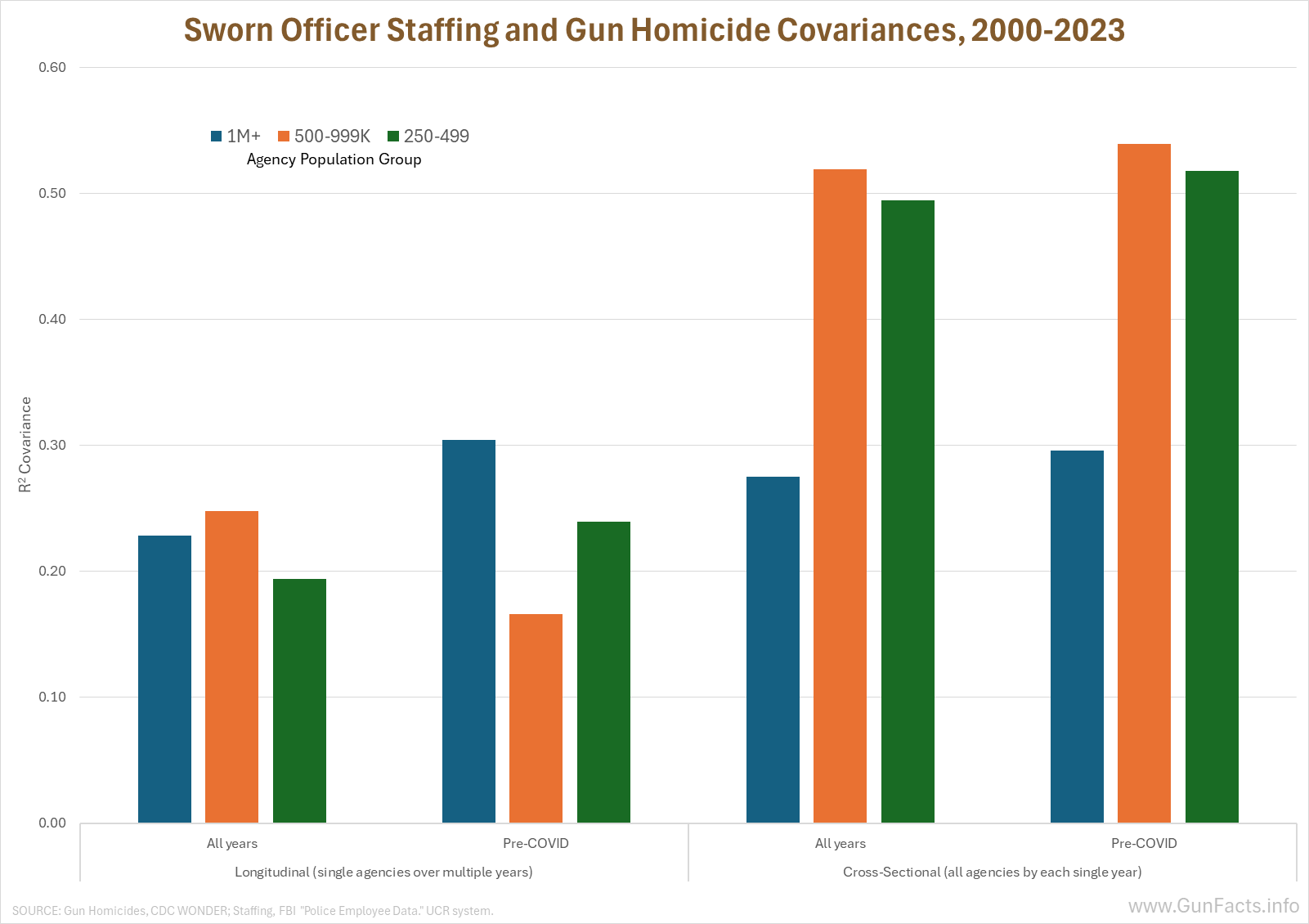 For all sworn duty officers inside large cities, we see two different effects.
The longitudinal measure (studying individual agencies over many years) shows a correlation between the number of full-time sworn duty officers of all types and lower gun homicide rates. The effect (R2 average of 0.24) Is on the low end of moderate correlation. That is interesting in and of itself, but the cross-sectional covariance (across all agencies for a single year, in this case 2019) is much stronger at 0.45.
Second big warning: there were only ten cities with more than a million people to analyze. That small number makes some calculations statistically delicate.
As an exercise we separately viewed Chicago. They came in with a slope of 0.42. What this basically means is that for each increase of 1 officer per 1,000 residents, the homicide rate decreases by ~4.2 per 100,000 residents (on average, over time, in Chicago).
And here is why agencies in huge cities are not staffing up aggressively. In 2019, the year for which we did our primary cross-sectional investigation, there were 2,693,976 people in Chicago 2. To add one more officer for every thousand residents would require hiring just under 2,700 new officers, or about a 20% increase in staffing.
That’s not cheap.
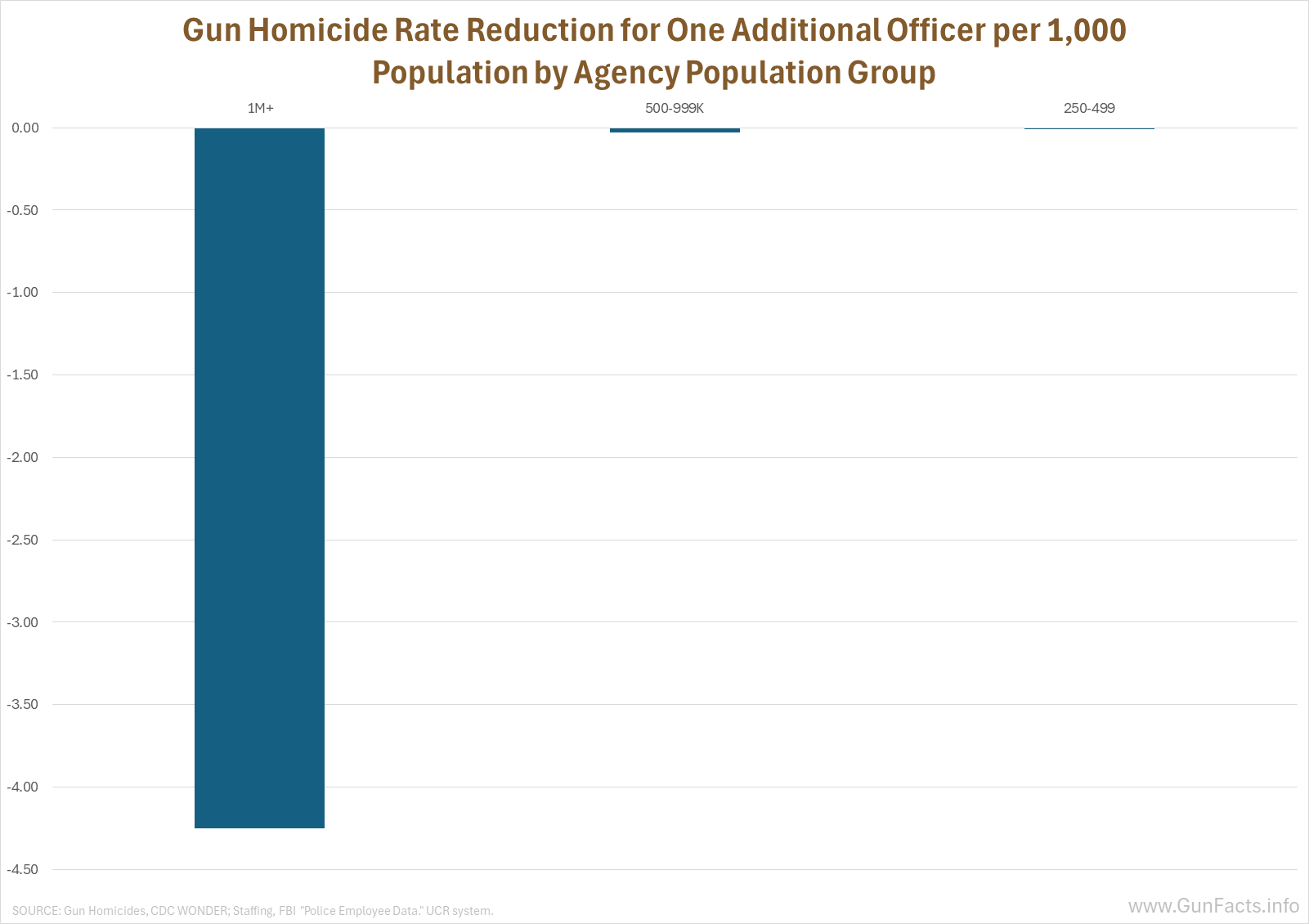 The next question after determining that there is an officer/homicide correlation concerns how much affect sworn officer staffing has on gun homicides. And here we see a huge distinction based on the size of the population served by the agencies.
As has been endlessly noted by us and sundry criminologists, street gang violence is significantly concentrated in a few major metro areas. Thus, cities with a large population see the most dramatic effects of having more officers on their force. The smaller the population, the lower the gang infestation rate and the lower the gun homicide rate, and hence the less effect more officers or detectives have.
Do detectives make a difference?
One of the things we noticed in our Top 15 Murder Counties study was that major metro areas with high gun homicide rates also had terrible homicide clearance rates. Police departments were unable to identify who murdered somebody else. Nationally police agencies have a 68% homicide clearance rate. In other words nearly a third of people who commit murder get away with it. In our top 15 murder counties, homicide clearance rates drop to 54%. The poster child for street gang homicides, Chicago, Illinois, in the year of our study achieved only a 35% clearance rate, and some news reports indicate that that may have been padded. 3
Since detectives do most of the work in clearing cases and since sending a gang member to prison for a homicide tends to keep them from committing other homicides, it makes intuitive sense that a higher ratio of detectives to patrol officers might have some bearing on clearance rates and thus some indirect bearing on gun homicide rates.
The data, oddly though, only lightly supports this contention. But with so many variables involved between different police agencies in different states, we have to accept that the measurable effect may be muted.
| RSQ | Slope | |
| Detective/Patrol Ratio | 0.10 | -48.00 |
One of the interesting confounding conditions is that nearly all of the agencies within the top two population groups have specialized gang units. This means that all of these agencies have actively integrated detectives into the gang suppression process. This is likely the most significant reason we don’t see a lot of variation between agencies in terms of the ratio of detectives to patrol officers affecting gun homicide rates. The covariance only achieves 0.1, which basically means a covariance too weak to positively assume a correlation. However, the effectiveness of having a high detective-to-patrol-officer ratio is steep, indicating that when you have a sufficient number of detectives on the force, it does have a significant suppressive effect on gun homicide rates.
What this means to everybody
As the Top 15 Murder Counties studies showed, gun violence is insanely concentrated in a few counties across the country, and in those counties it is typically concentrated in one major metro city. By and large most agencies across the country don’t need to do anything. They are likely adequately staffed (though adding more officers certainly would not hurt).
But for the major metro areas where there is significant violence and significant street gang activity, adding officers makes a measurable and significant difference. There is an open question as to whether it’s more patrol officers, more detectives, or more of both that would be best. But increased staffing is a primary tool, if not the primary tool, for rescuing innocent people in poor neighborhoods from gun violence.
Comments
Cops and Gun Crime — No Comments
HTML tags allowed in your comment: <a href="" title=""> <abbr title=""> <acronym title=""> <b> <blockquote cite=""> <cite> <code> <del datetime=""> <em> <i> <q cite=""> <s> <strike> <strong>