
Domestic Gun Violence Perspectives
A police detective once joked with us that he was confused at a scene because he couldn’t tell whether there was domestic violence or if the couple were into BDSM.
Cop jokes aside, domestic violence is serious. Gunplay is serious. But we find out that the rate of gunplay in domestic violence is both rare and compartmentalized.
Takeaways
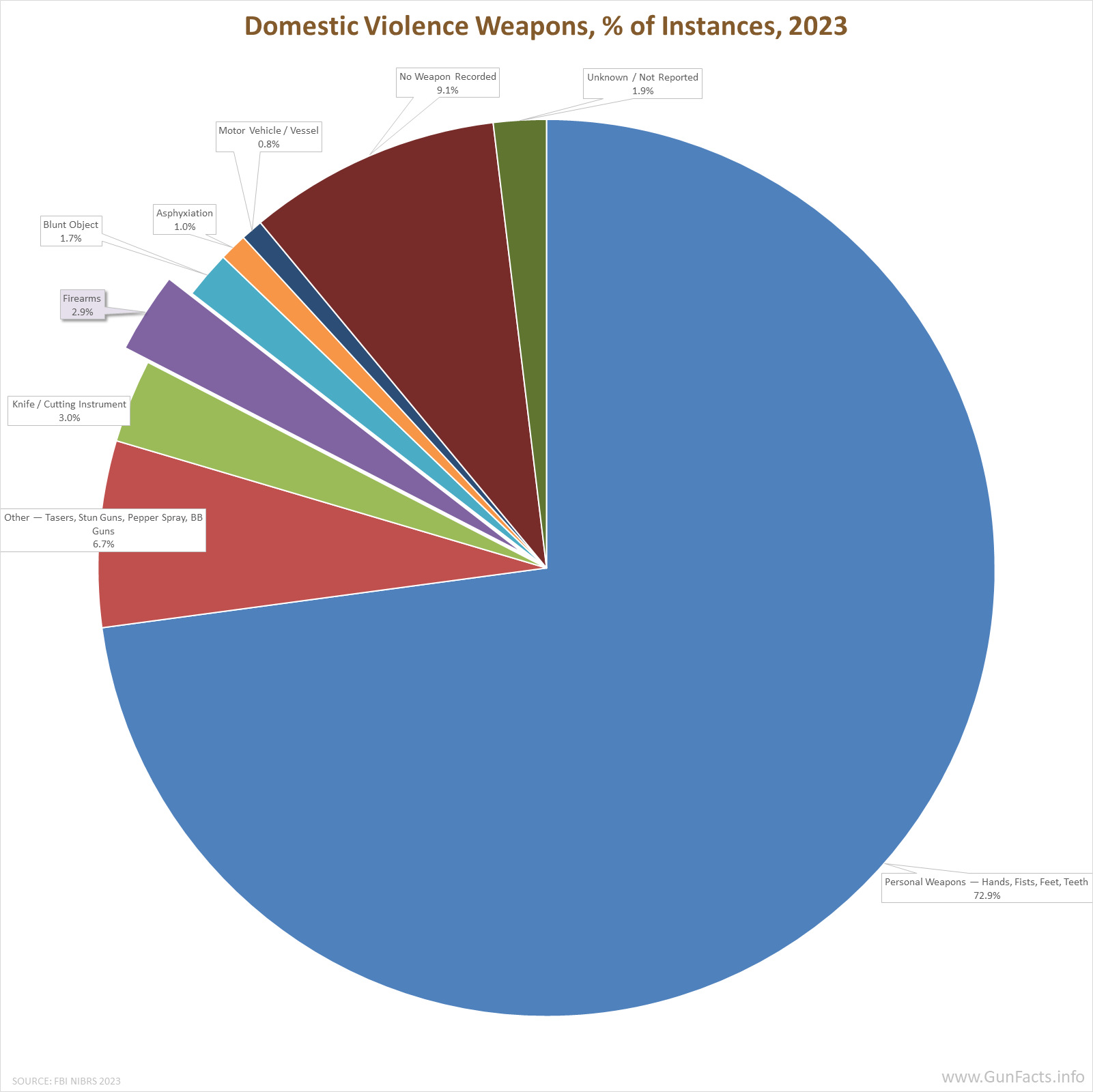
- Guns are used in less than 3% of all domestic violence incidents.
- That drops to 1.3% if we eliminate merely brandishing a firearm as an act of intimidation.
- The rate of firearms in domestic violence between same-sex couples is nearly four times higher than their percentage of the population would otherwise predict.
Cause(less) concerns
We don’t take domestic violence lightly. In 2023, the year for which our data was extracted, there were over 877,196 incidents of domestic violence. We say “over” because our data comes from the FBI’s NIBRS data collection system. Even in 2023, 11% of local agencies (including all of Los Angeles) had failed to file their crime reports with the FBI. That was a damn sight better than the year 2021, when NIBRS was launched and about 40% of agencies failed to respond.
 |
 |
 |
 |
 |
 |
 |
And we don’t take gun violence lightly either. But gunplay and domestic violence incidents accounted for only 2.9% of the weapons used. 1
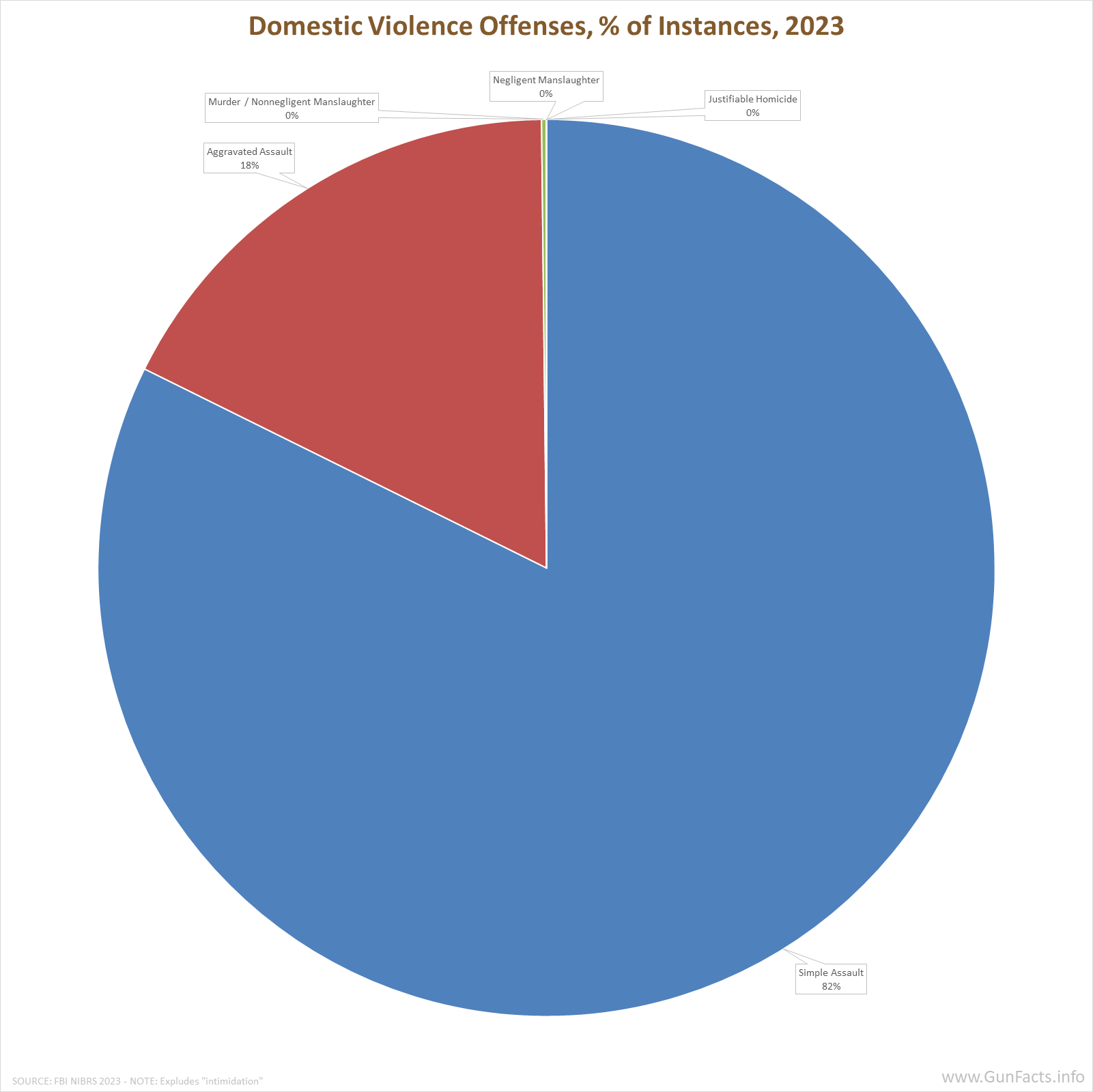
The reason that gunplay is so infrequent in domestic violence is that most domestic violence is of the lowest levels. Over 82% of all domestic violence instances are simple assaults, which generally mean shoving, punching, kicking without serious outcomes. Just to be abundantly clear, the FBI’s definition of simple assault is “An unlawful physical attack by one person upon another where neither the offender displays a weapon, nor the victim suffers obvious severe or aggravated bodily injury involving apparent broken bones, loss of teeth, possible internal injury, severe laceration, or loss of consciousness.”
This begins to show how relatively little gun violence, at least in terms of people being injured by bullets, actually occurs—but let’s dive down into just those instances of domestic violence where guns were involved for an even clearer view.
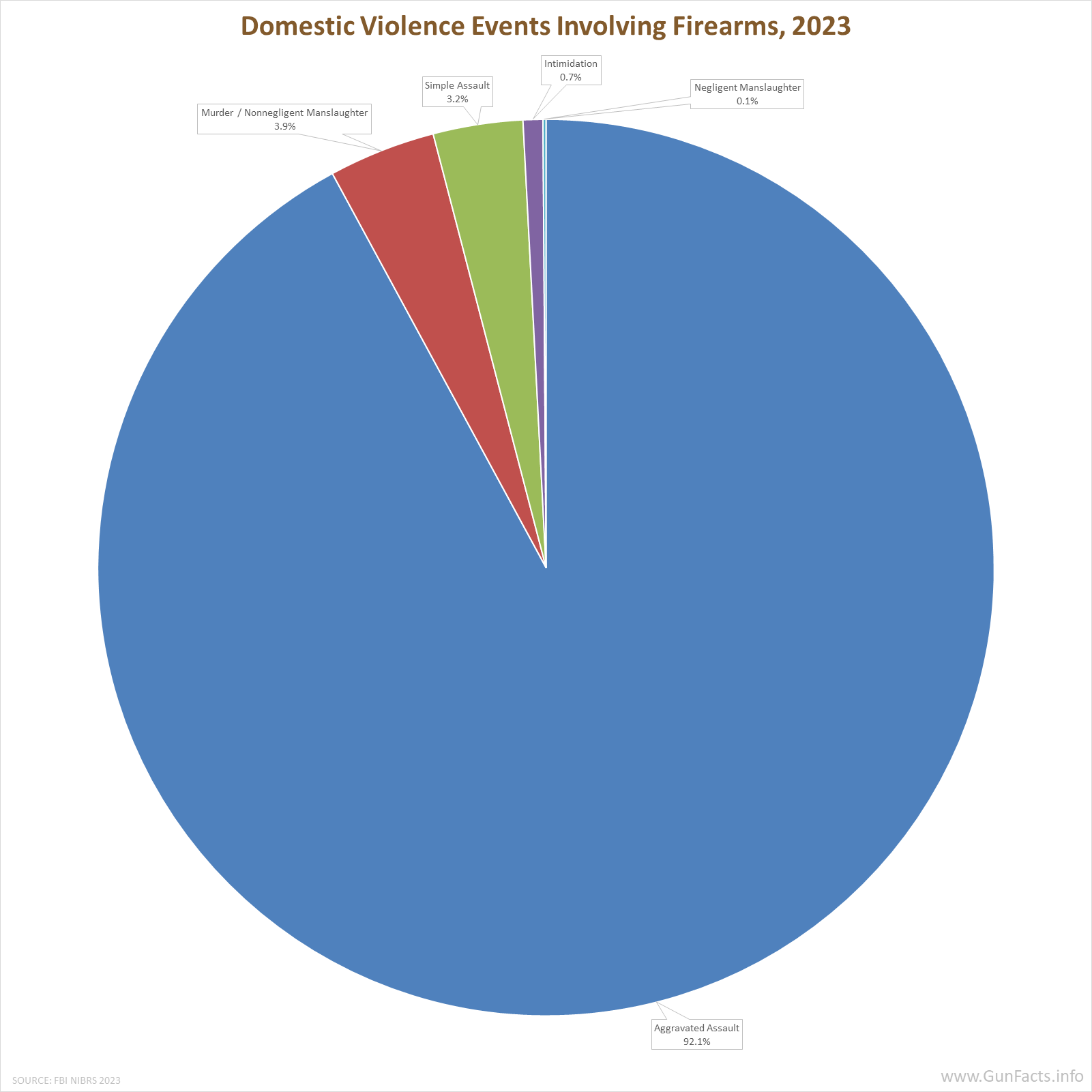
In terms of bloodshed, there is not as much as you would think. Ninety-two percent of all domestic violence events involving a firearm are aggravated assaults. But the FBI’s definition of aggravated assault is amazingly broad. For example, the following two qualifications exist to the FBI’s core definition:
“In addition, this offense usually includes offenses such as pointing and presenting a firearm, brandishing a firearm, etc.”
And critically:
“It is not necessary for injury to result from an Aggravated Assault when an offender uses a gun, knife, or other weapon which could cause serious personal injury.”
In that 92% of domestic violence events that involve a firearm, some portion of those only involve brandishing and don’t involve firing the weapon.
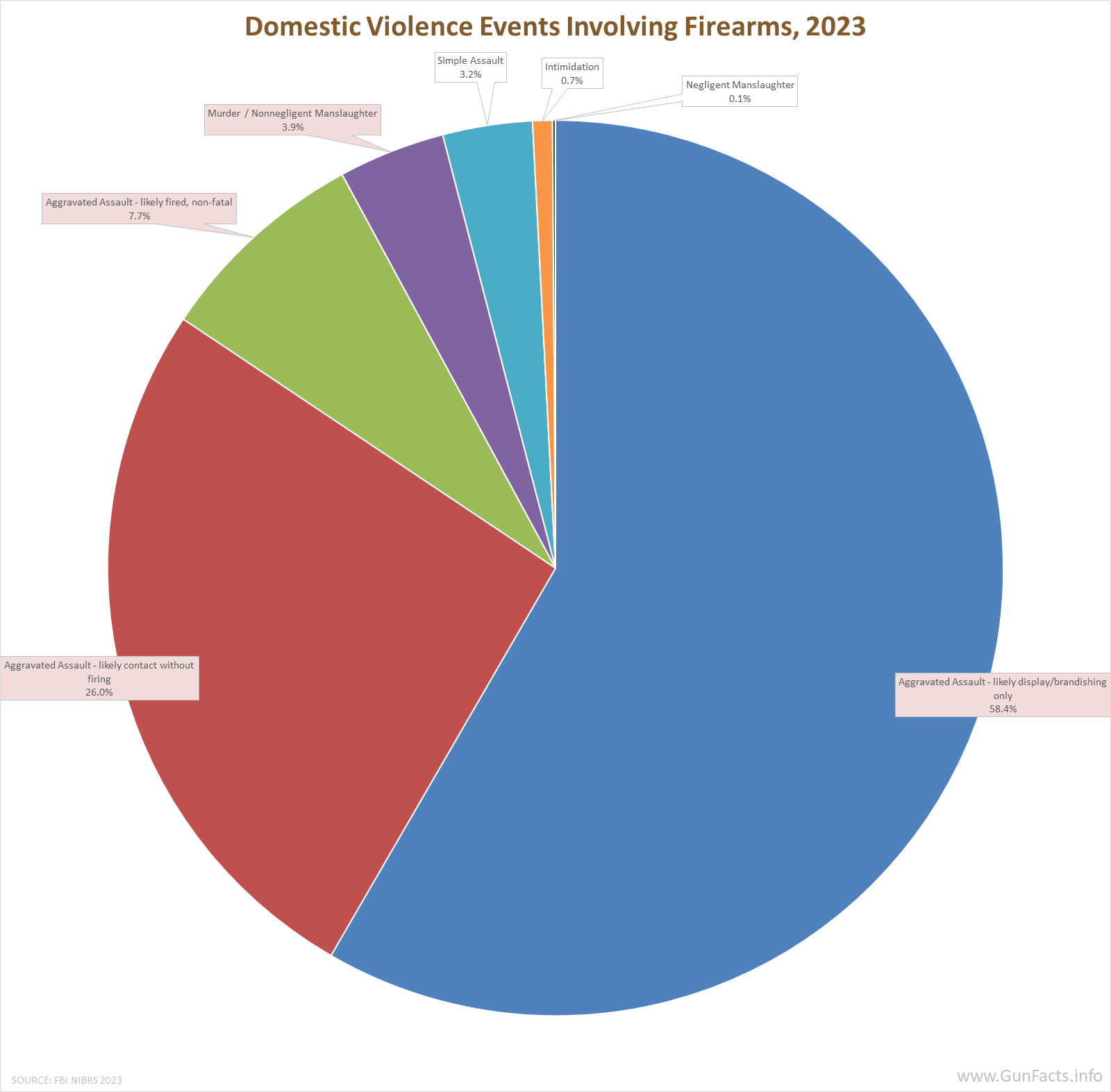
The question is: What is the breakdown of those aggravated assaults? Unfortunately, the answer is: We don’t know.
The NIBRS system does not provide data that informs us about how violent these aggravated assaults with a firearm are. However, being a little clever we devised a rubric using the reported injury of the victims and, making some not outlandish assumptions, we were able to narrow that 92% in a meaningful way.
If our assumptions are correct about injuries describing the actual use or non-use of firearms in a domestic violence event, we see that now over 58% of armed domestic violence events are merely brandishing. Combined with the total number of domestic violence events that involve a firearm, that means maybe 1.3% of all domestic violence events involve somebody firing a gun. And given that some people may fire a gun to intimidate or scare somebody or that they just miss, the net carnage level drops even further.
People committing domestic violence with guns
It is not terribly surprising that people in their twenties tend to be stupid with both guns and domestic partners.
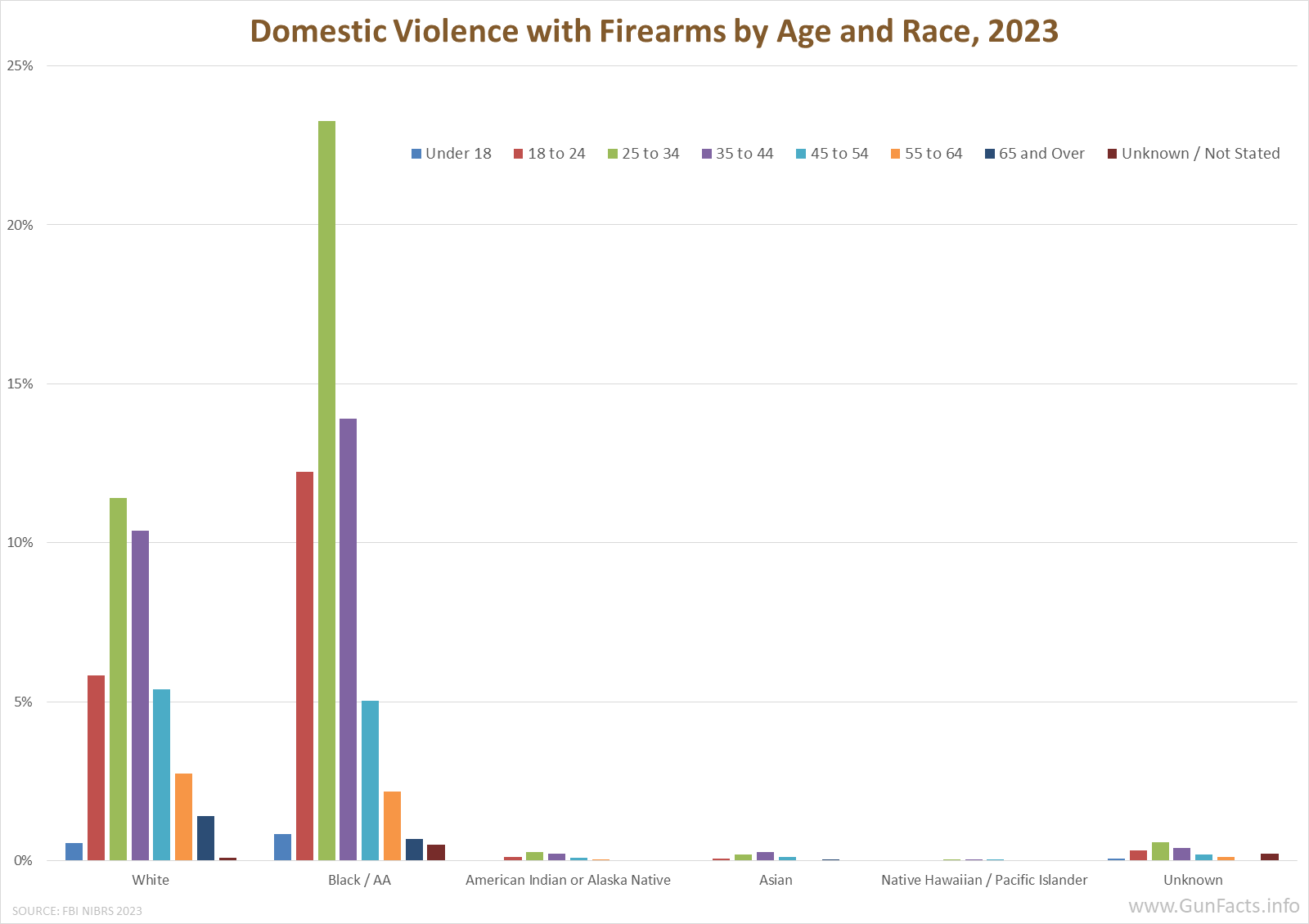
We did not bother to parse out men versus women in this particular chart. We were more interested in whether there were age and race differences in terms of gunplay and domestic violence.
There are.
The rates go up when people are of an age to marry. They climb steeply in the 25-to-34-year-old age group. For whites, they pulled back their partner violence rates slightly in the next age group. But for blacks, gunplay in domestic violence is higher all the way around (based only on their share of domestic violence events, unadjusted for race population ratios) and significantly higher in the 25-to-34-year-old cluster. We’re unsure of what this means but it is interesting.
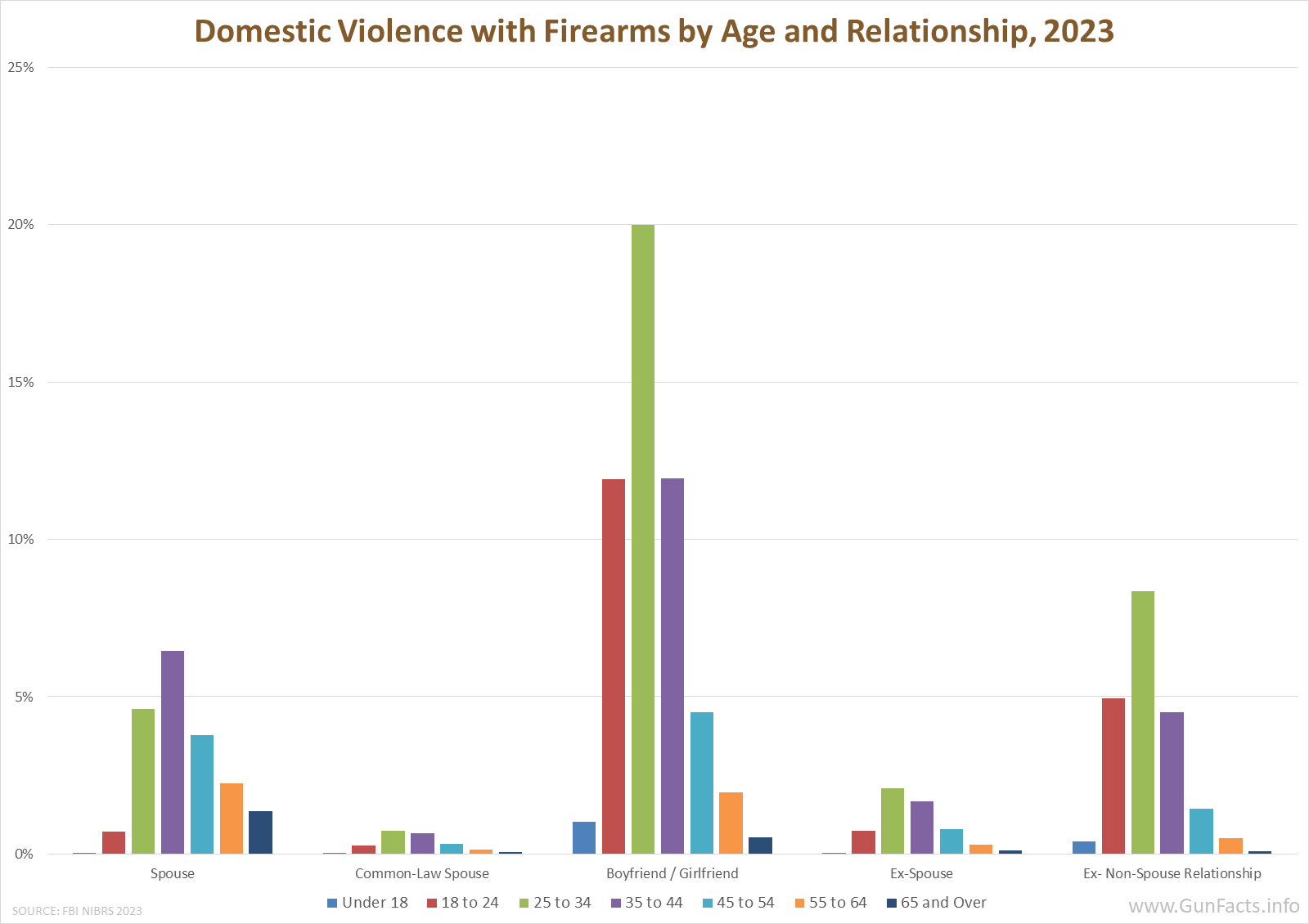
And when it comes to the type of relationship, some of the patterns we observe with firearm domestic violence are fairly predictable.
We see gunplay concentrated in the early adult years between boyfriends and girlfriends or their exes. But we see a bump in spousal domestic violence involving a gun in the early middle age span. Of minor passing interest is that domestic violence involving a gun is lower among ex-spouses, where you might think post-divorce acrimony would elevate such.
Domestic violence with guns against sexual orientation
This is going to upset some people.
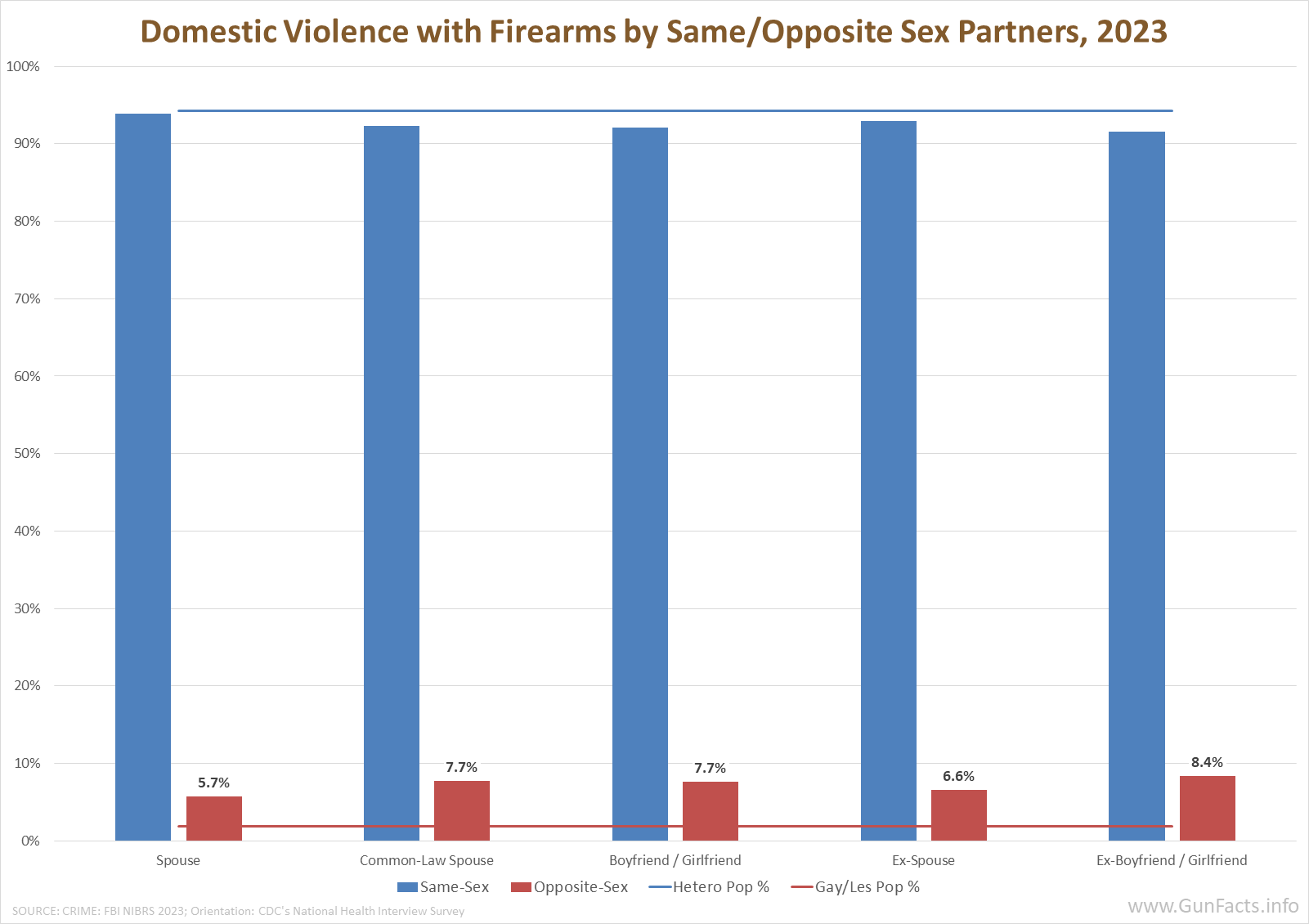
We decided to see if sexual orientation between domestic partners was very different in terms of gun use in domestic violence. For this query we had to find a data source that measured sexual orientation. We relied on the CDC’s National Health Interview Survey and did a sanity check on surveys done by the Gallup Poll and feel reasonably confident about those estimates, though the numbers are significantly lower than what activists in the LGBTQ+ community claim the percentage of the population to be. And we do accept that a lot of people may not be telling the truth about their sexual orientation when surveyed. Since there’s no way to untangle that, we have to go with the numbers that we found.
And we see something a little disquieting.
Among heterosexuals the ratio of those who commit firearm-related domestic violence falls a little bit short of what their percentage of the population would predict. However, among same-sex couples the ratio is as high as 4.2 times more than the population would suggest based on different age groups. Across all age groups it’s just shy of 4X.
We’ll avoid playing pop psychology as to why this may be, but it was unexpected and might be of interest to social psychologists.
Domestic bliss or bullets
The good news, if you can call it that, is that gunplay in domestic violence is really small as a percentage of all domestic violence. It gets even smaller when you factor out brandishing of a firearm as a mode of intimidation “violence”. The rate then is so low that it is approaching a fraction of a percent.
That’s the good news. The bad news is that there are still a lot of people committing violence against their partners regardless of age, sexual orientation, and race. Though it skews differently in some metrics, it’s more important just to get people who allegedly like one another to not harm one another.
Notes:
- We have excluded the crime category of “intimidation” so that we can focus on actual bodily harm, which is materially different than just scaring somebody. We also omitted the category of drugs as a weapon type because untangling that, as a precursor to violence or even possibly victims making false claims when they have recreationally taken drugs, gets too complex to unwind. ↩
Comments
Domestic Gun Violence Perspectives — No Comments
HTML tags allowed in your comment: <a href="" title=""> <abbr title=""> <acronym title=""> <b> <blockquote cite=""> <cite> <code> <del datetime=""> <em> <i> <q cite=""> <s> <strike> <strong>