
“Safe Storage” Realities
“Safe Storage” laws appear to have a measurable effect—but it’s small, focused in one area, may have been a side effect of something completely unrelated, and in the big picture is not a game changer.
Take-aways
- Compared to states that never enacted safe storage laws, there is a measurable additional decline in teenage firearm suicides.
- But there were also drops in other forms of teenage suicide.
- Most of these instances, though, are covariant with a strong increase in prescribing psychotropic medications, particularly SSRIs, to teenagers during the same period, which may have reduced suicidal ideation.
The goal for safe storage laws
Safe storage laws were conceived to try to protect unsupervised young people from doing stupid things with guns. The two stupid things that young people did with guns were to accidentally shoot themselves or somebody else, or to commit suicide.
| 1989: Florida 1990: Connecticut, Iowa 1991: Maryland, Nevada, Virginia 1992: California, Hawaii, New Jersey, Wisconsin 1993: Minnesota, North Carolina 1994: Delaware 1995: Rhode Island, Texas 1998: Massachusetts 2000: Illinois, New Hampshire 2009: District of Columbia |
 |
 |
From the late 1980s onward, 19 states passed such laws. There are variations in these laws but they all rest on the premise that if you have a gun and you have a reasonable expectation of a child or a teenager being in your home, you’re supposed to secure your firearm in such a way that they allegedly cannot get to it.
We say allegedly because kids are pretty inventive and they’ve proven that they can get into at least some of the more inexpensive gun lock-boxes by picking the combination or jimmying the lock.
That aside, we have interesting natural experiments here given the staggered pacing of enactment of “safe storage” laws in these states. In this research we compared those states against 24 other states that never passed any form of safe storage laws.
But even entering into this study we already knew about some realities, and thus knew in advance some of the problems that we faced.
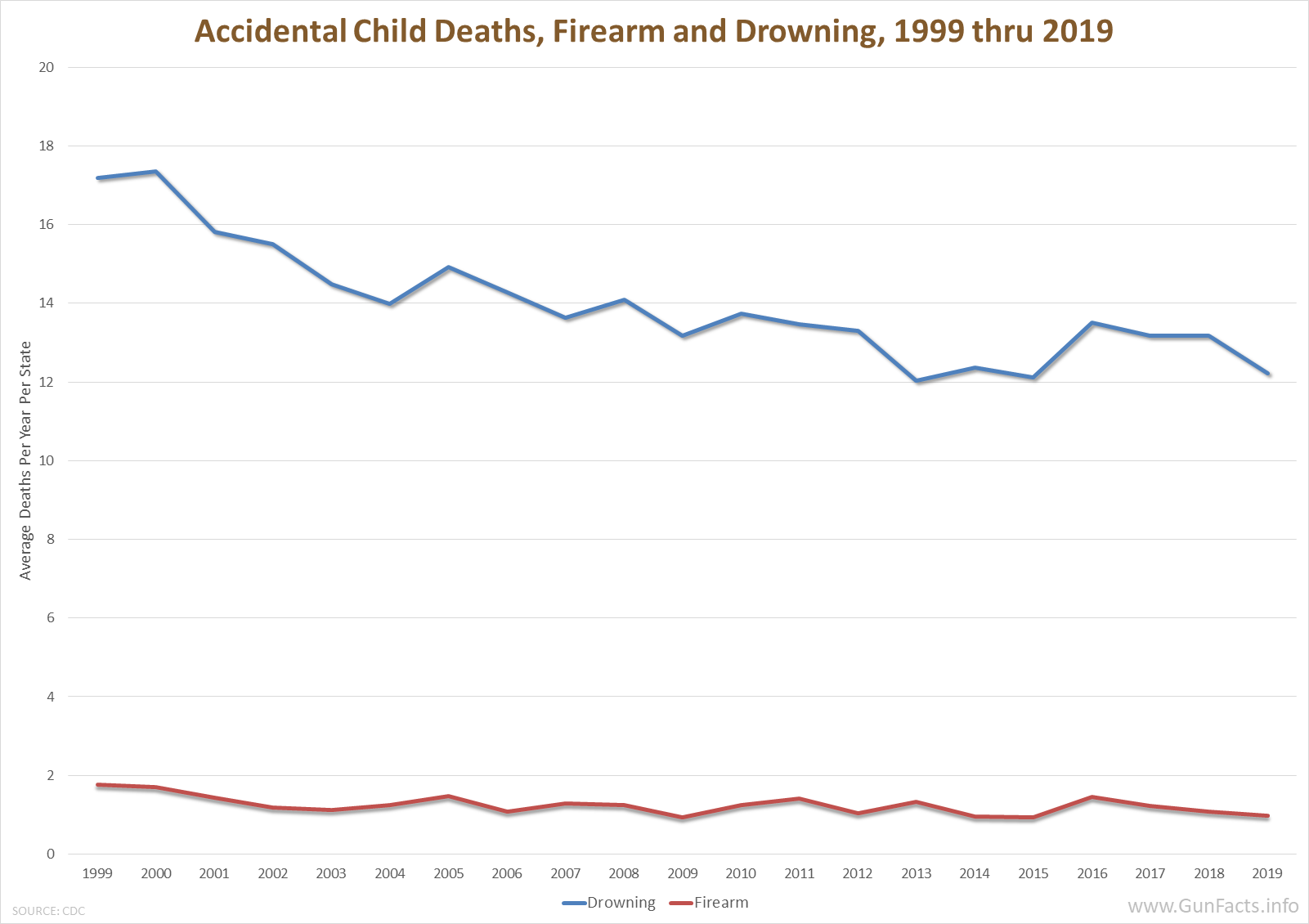
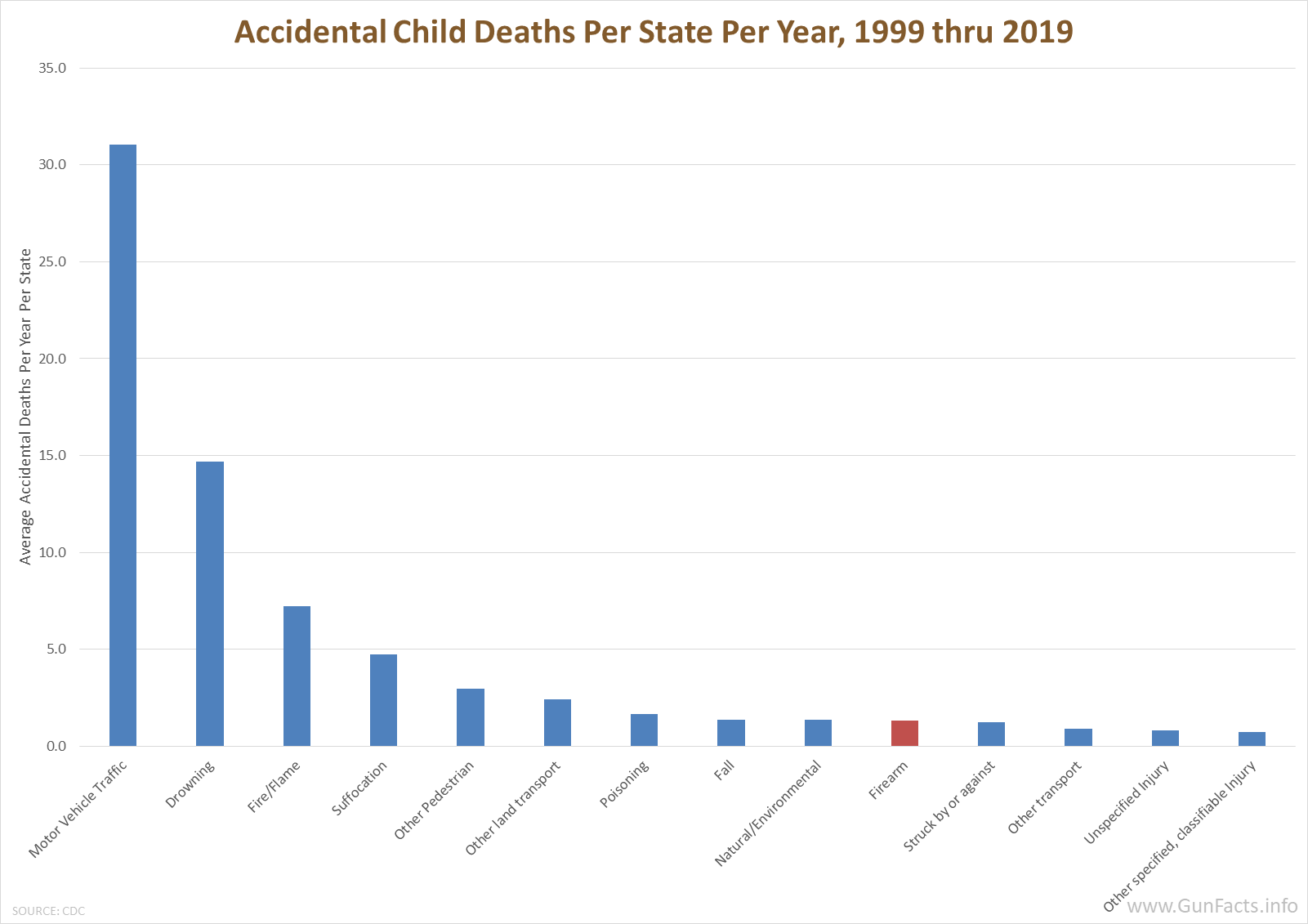
The first among these is that for children, suicides are functionally non-existent and the rate of accidental deaths with firearms is consistently about one child per state per year over time.
That is why among children, firearms are not the leading cause of death. They are not even the leading cause of unintentional deaths. They are, in fact, only the 10th leading cause of unintentional deaths, and that is barely below being killed by Mother Nature.
To give you an idea from a different perspective, when we asked the Centers for Disease Control to dump out the accidental firearm death rates and counts by state for individual years, a mere 0.1% of all of the data points had data large enough that the CDC would share it. All the rest were set to zero or suppressed for privacy reasons.
This makes for a statistical measurement impossibility. When the rate of deaths is this low, the effects of any law would be uniquely unmeasurable. Hence, we will not be evaluating the effect of these laws on children because, statistically speaking, they could not possibly have a measurable impact.
Teens are a little bit different.
Becoming a teenager brings on a lot of changes. Most of these are nominal, inconvenient to parents, and at worst mildly criminal. But among the changes are increased degrees of risk-taking and the development of new mental orders and disorders. Because of this, teenagers who find a gun and who are not well trained in gun safety will occasionally do stupid things with a gun, such as pointing it at somebody while believing that the safety is on or that the gun is unloaded, when it is neither.
More sadly, though, some teenagers start to develop mental disorders—from mild depression all the way up through psychosis. With these disorders occasionally comes suicidal ideation. Suicidal ideation paired with any means for committing suicide, including guns, unfortunately results in some teens killing themselves.
Both unintentional and suicidal deaths are much more numerically robust in the CDC data and they allow us to at least dig into whether safe storage laws affect outcomes for them.
Teenagers, guns, unintentional deaths and suicides
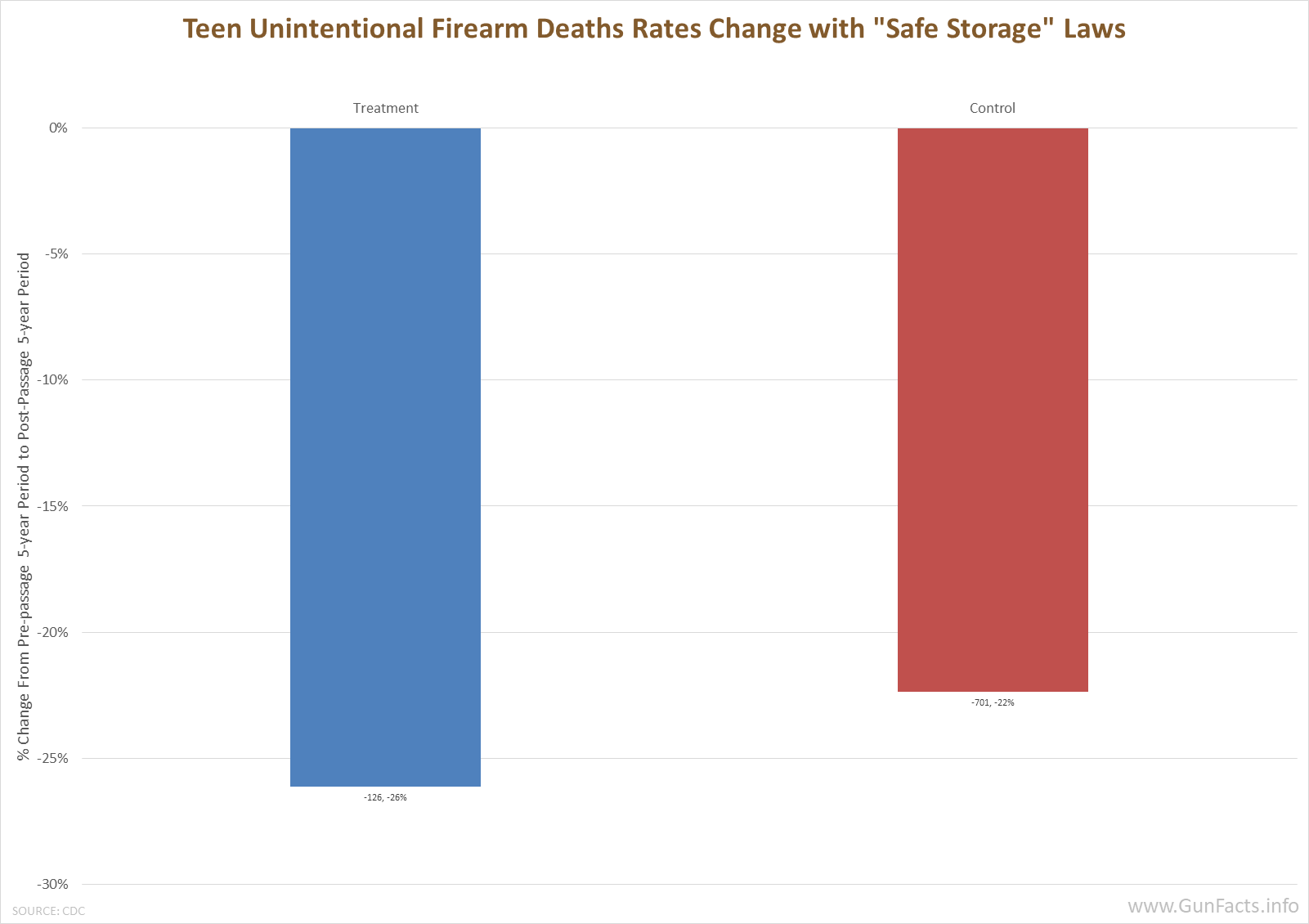 When it comes to stupid teenagers doing stupid things with guns, safe storage laws (not controlling for other variables) appear to have minimal measurable effect. It’s worth noting that in the control states (states that never enacted safe storage laws), accidental gun deaths of teenagers also declined when compared to states that did have safe storage laws (treatment). But the rate of change in treatment states was larger.
Rates and the number of reduced deaths, however, are different things. Despite having some large population states participating in safe storage laws, the total number of reduced deaths was pretty small. “Only” 126 accidental deaths were possibly prevented by safe storage laws; though with numbers that small this becomes questionable. In the 24 control states, 701 fewer teens accidentally died from bullets in the same study periods. 1
This is due mainly to the states not having many teenage gun deaths to begin with. For all 19 treatment states for the five years before they enacted their laws (95 “state years”) a mere 549 teens unintentionally got shot. That’s roughly 29 per state over five years or less than six per year. In 1999, the midpoint of all the years in this study, there were 20,084,602 teenagers. This means that only about 0.001% of teenagers in a given year would be accidentally killed with a firearm.
But those are the unintentional deaths. It’s the intentional deaths via suicide that are concerning, though the data and a huge non-gun anomaly will make reckoning a bit tricky.
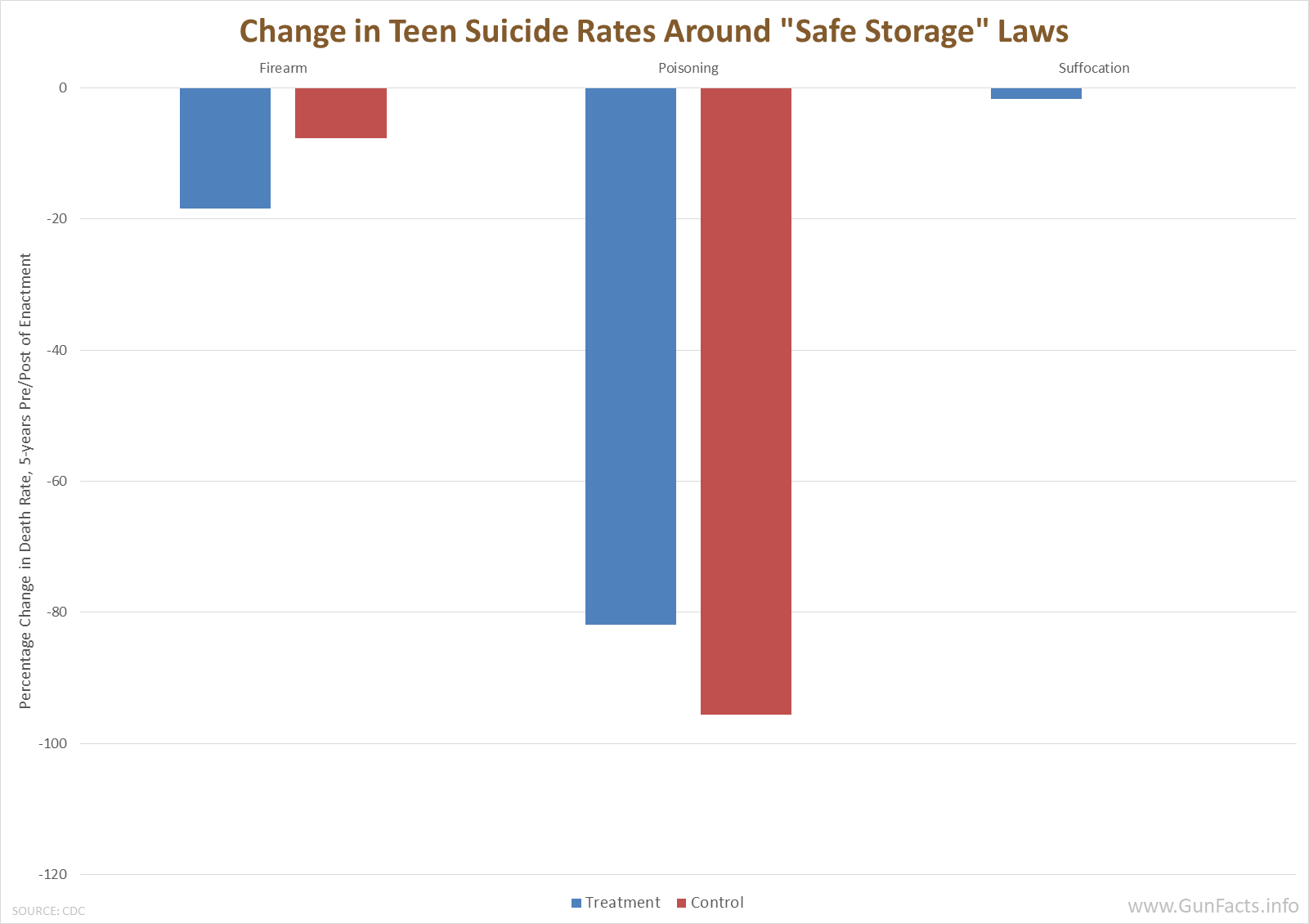
For suicides, we’re going to present two charts. The first one is a bit misleading and the second one shows you why.
 |
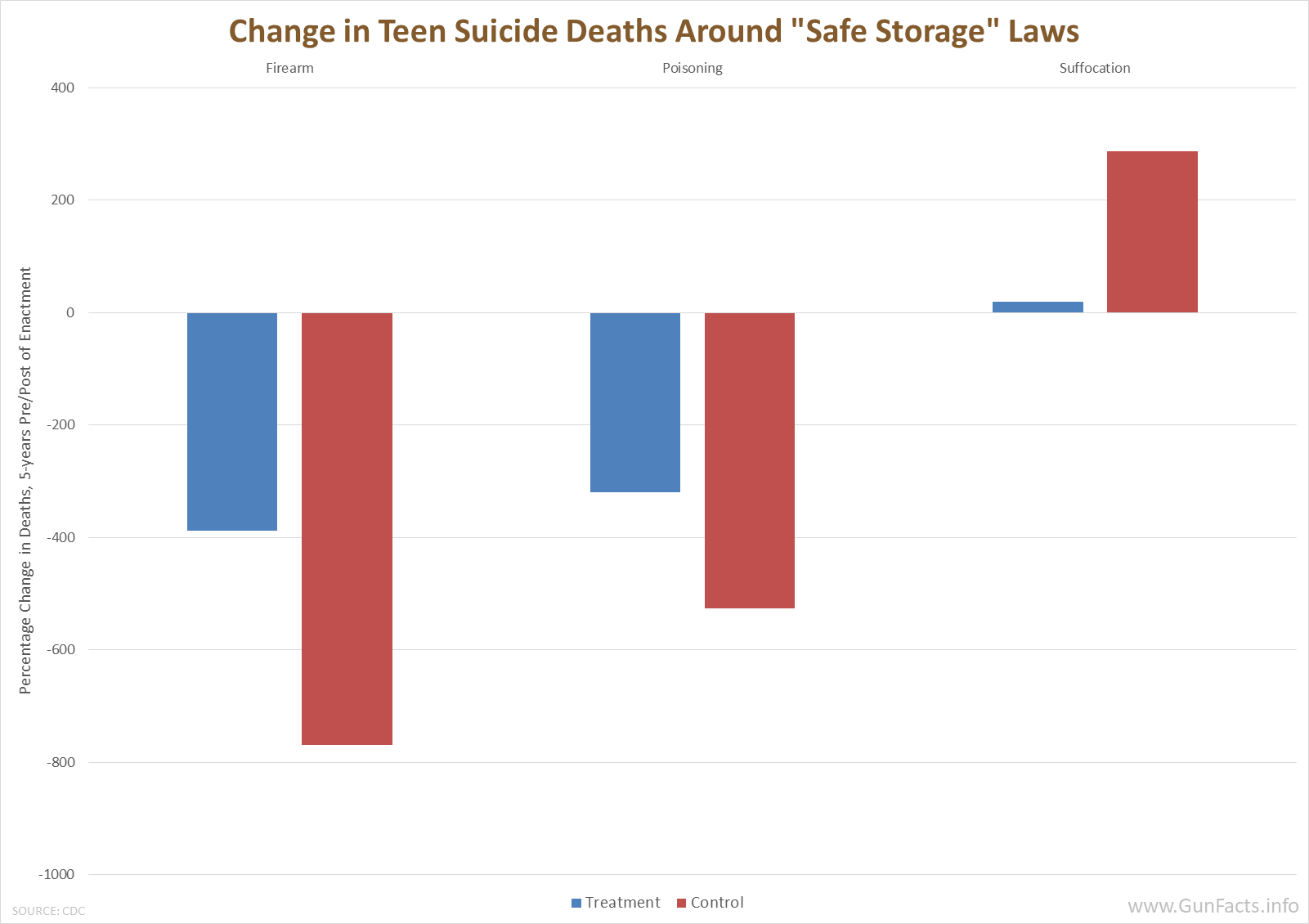 |
The rate of change for teenage suicides using firearms was small when compared to the rate of change for teenage suicides using poisoning during the same periods. More interestingly in the treatment states, the states that passed safe-storage laws, the firearms suicide rate dropped faster than for control states, but at the same time the suicide rate using poisoning fell faster in the control states.
[Special note: The poisoning decline looks more dramatic than it is. The number of poisoning deaths is low so the rate of decline for even a handful of teenagers not using this means to commit suicide is very large. And two states — Ohio and Pennsylvania — Had unusually high teenage poisoning suicide deaths in the years before the safe storage gun laws but not afterwards and these really distorted the measurements.]
Both these and some very high-level numbers show that over the span of our study teenage suicide rates were falling in general. Thus, some of the decline in firearms suicide rates has to be attributable to an effect outside of the availability of a gun.
This becomes a bit more obvious when we look at the raw numbers of teenagers who committed suicide by various means during the study period. The rate of decline in firearm suicides looks marginally better in the states that have passed safe storage laws. On a state-averaged basis the firearm suicide totals in states that never passed a safe storage law fell more aggressively. In fact, the only category where teen suicides were less favorable to control states was where suffocation was involved. As far as we know, there were no plastic bag restriction laws anywhere.
Psychotropic medications and teen suicides
While looking for confounding variables, we came across reports about the change in attitudes for prescribing psychotropic medication to teenagers during the study era.
This topic is controversial, to say the least.
Some teens suffer from mild to serious depression, and depression is a key determinant variable for suicidal ideation. If more teens were prescribed more psychotropic medications, in theory there would be fewer teenage suicides regardless of the means.
 That appears to be a compelling factor.
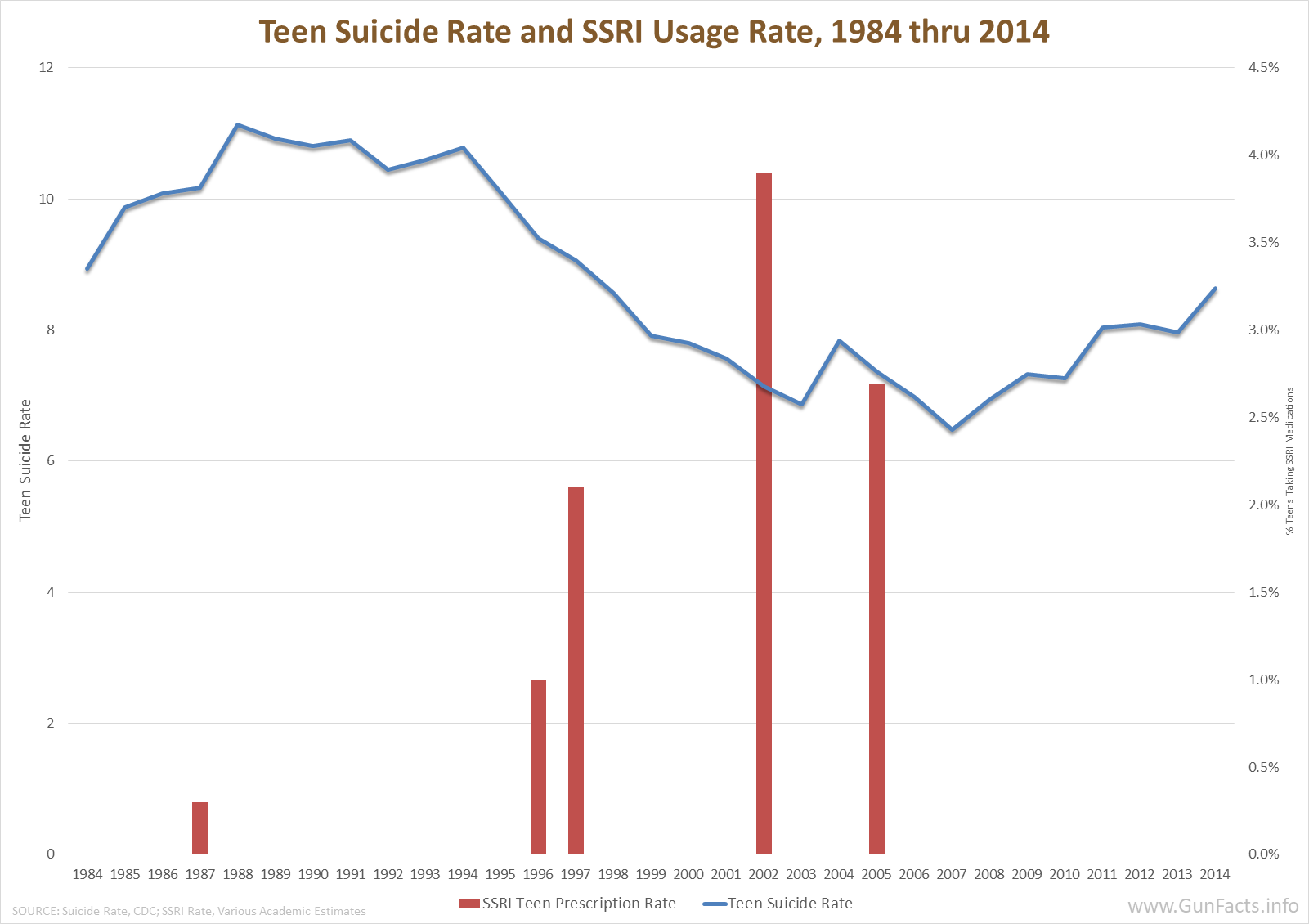
Though there is no consistent annual measurement of how many teens are prescribed psychotropic medications, there have been a series of measurements specifically about SSRIs (selective serotonin reuptake inhibitors) being prescribed to teenagers. 2 Though not solidly conclusive by any statistical measure, we do see some covariance in the increased use of these medications and a long-term decrease in teen suicide rates.
Additionally, when the FDA issued some black box warnings in the early 21st century, which may have encouraged some parents or teenagers to stop taking such medications, we see an upward creep in teen suicides.
The key point here is that the drop in suicide rates is covariant with the drop in firearm suicide rates, which is, in many instances, covariant with the passage of safe storage laws. The small gains allegedly made with these laws may not be attributable to these laws at all. They may be primarily or even completely associated with social changes and changes in mental health interventions within an at-risk population.
Safe storage walls may be ineffective
At best we can say that safe storage laws may have created a small decrease in teenage firearm misuse, be it for accidents or suicides. But the decrease in the actual number of lives saved, even if this were accurate, is minimal.
Due to the confounding covariance with increased use of psychotropic medications for at-risk teenagers, the alleged gains of safe storage laws might be anywhere from overstated to completely fictional.
Notes:
- We’ll note that for both the treatment and control states, there was a tiny number of CDC suppressed cells but not enough to radically distort this comparison. ↩
- Olfson M, Marcus SC, Weissman MM, Jensen PS. National Trends in the Use of Psychotropic Medications by Children. J Am Acad Child Adolesc Psychiatry, 2002; Vitiello B, Zuvekas SH, Norquist GS. National Estimates of Antidepressant Medication Use Among U.S. Children, 1997-2002. J Am Acad Child Adolesc Psychiatry, 2006.; Vitiello B, Zuvekas SH, Norquist GS. National Estimates of Antidepressant Medication Use Among U.S. Children, 1997-2002. J Am Acad Child Adolesc Psychiatry, 2006.; Lu CY et al., ‘Changes in antidepressant use by young people and suicidal behavior after FDA warnings and media coverage’, BMJ 2014;348:g3596 ↩
Comments
“Safe Storage” Realities — No Comments
HTML tags allowed in your comment: <a href="" title=""> <abbr title=""> <acronym title=""> <b> <blockquote cite=""> <cite> <code> <del datetime=""> <em> <i> <q cite=""> <s> <strike> <strong>